
Why Is My Espresso Machine Not Building Pressure? 8 Common Causes and Fixes
If your espresso machine is not building enough pressure, do a few simple checks before assuming the pump has failed. Separate coffee-preparation issues from water-flow problems first.
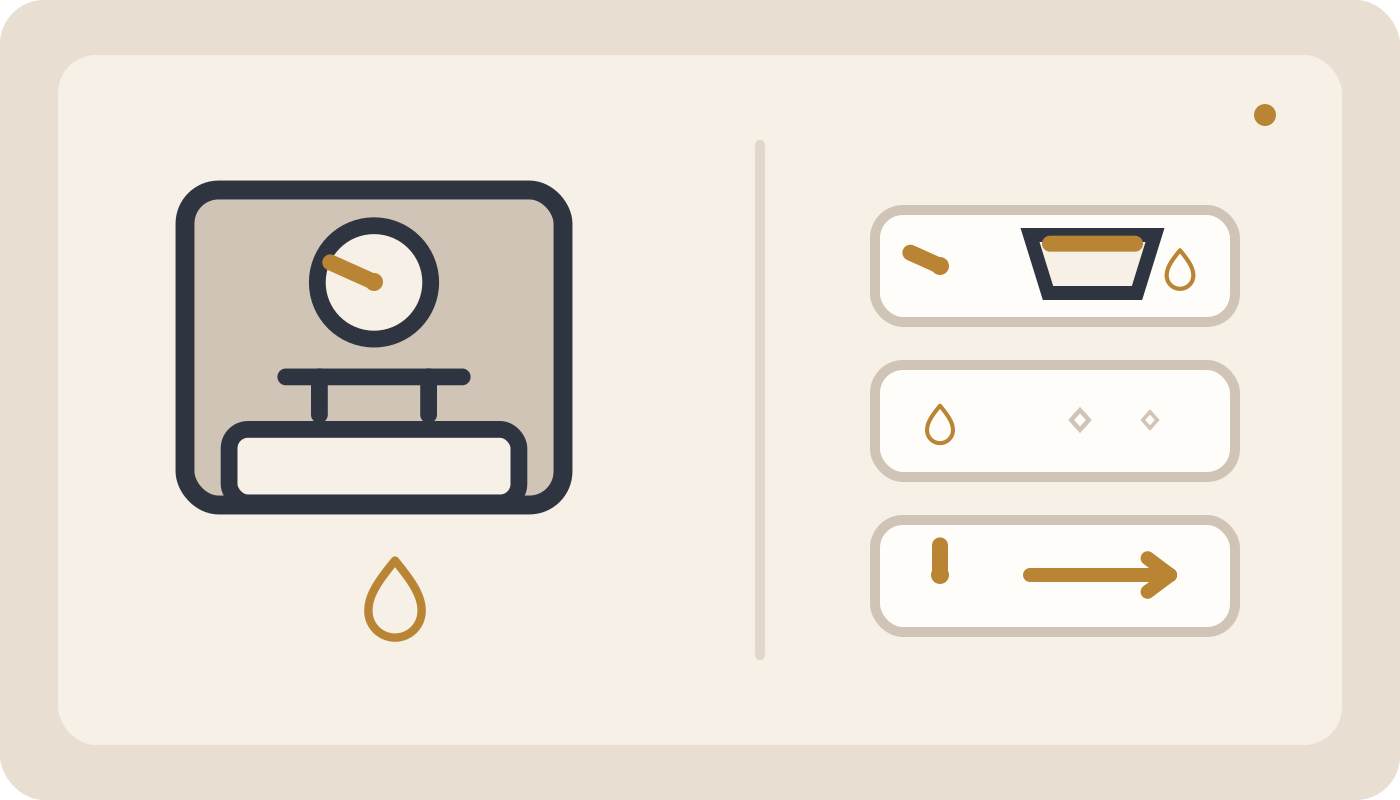
Low pressure does not always mean a failed pump. First run the machine without the portafilter. If water flow is normal, check grind size, dose, tamp and basket blockage. If flow is weak even without the portafilter, check the tank, scale buildup and water path.
Where should you start?
Why does espresso pressure drop?
Low pressure or abnormal water flow does not automatically mean the pump has failed. Grind size, coffee dose, tamping, a blocked basket or scale in the water path can all change extraction. The first task is to separate a coffee-preparation problem from a machine water-flow problem.
1. Test the machine without coffee
Remove the portafilter, confirm that the tank contains enough water, and run a short water cycle. If water flows normally from the group head, start with grind size, dose, tamp and basket cleanliness. If flow is weak even with the portafilter removed, continue with the tank, scale buildup and water path.
Diagnostic principle: first determine whether the problem is creating water flow or passing water through the coffee puck.
2. The grind is too fine
An excessively fine grind creates high resistance and can reduce the flow to a slow drip. Move only one step coarser and compare the result. Large adjustments make the real cause harder to identify.
3. The basket is overdosed
Too much coffee restricts the space available for water flow. Match the dose to the basket and the instructions for the specific machine; one fixed dose is not correct for every basket or model.
4. The tamp is uneven
The goal is a flat, repeatable coffee bed. An uneven tamp can create low-resistance paths and channeling. Focus on level and consistency rather than simply pressing harder.
5. The basket or group head needs cleaning
Fine coffee particles and oils gradually restrict basket holes and the shower screen. Inspect the basket against the light and clean it according to the manual. Do not use sharp metal objects to clear the holes.
6. Scale is restricting the water path
Mineral scale can gradually reduce water and steam performance. If the decline has been progressive, follow the approved descaling procedure for the model and avoid unsuitable chemicals.
7. Check the water tank and inlet
The tank must contain enough water and sit correctly in position. If it was completely emptied, the initial water feed may also be interrupted. Follow only the priming procedure specified for the model.
When should you stop troubleshooting?
If water flow remains weak without the portafilter after accessible checks and approved cleaning or descaling, an internal pump, valve or water-path issue becomes more likely. Opening the internal hydraulic or electrical system is not a consumer troubleshooting step.
Do not confuse pump health with puck resistance
Gauge behavior is the result of the pump, water path, basket type, and coffee-bed resistance. If free water flow is normal without the portafilter but pressure stays low while coffee runs fast, preparation variables are more likely than pump failure.
Use a three-step isolation test
- Confirm the tank is correctly seated.
- Run a short water-only cycle without the portafilter.
- Repeat with fresh coffee, a fixed dose, and one grinder change at a time.
Record pump sound, free-flow behavior, basket type, and whether the problem appeared suddenly or gradually before requesting service.
Common mistakes
Change only one variable at a time while diagnosing.
- Do not keep grinding finer without diagnosing the cause.
- Do not overfill the basket.
- Do not use excessive tamp pressure to compensate for another problem.
- Do not poke basket holes with sharp metal tools.
- Do not open the machine to inspect the pump or internal circuit.
- Do not use unapproved descaling chemicals.
Frequently asked questions
Does low pressure always mean the pump is faulty?
No. Grind size, dose, basket blockage, scale and water-supply issues can produce similar symptoms.
Why does water flow without the portafilter but not with coffee?
This usually points to excessive coffee-puck resistance. Check for a very fine grind, too much coffee or a blocked basket.
Why does espresso run too fast?
The puck usually has too little resistance. A coarse grind, low dose or uneven distribution can be responsible.
Does higher pressure always make better espresso?
No. Pressure alone does not determine extraction quality; grind, dose, temperature, time and extraction uniformity also matter.
Related guides and products
Still having the problem?
If safe user-level checks do not solve the issue, do not open the appliance. Submit a service request for technical inspection.