How Does Multi-Layer Stainless-Steel and Aluminum Cookware Spread Heat?
In clad cookware, stainless steel provides durability while an aluminum core spreads heat faster. Learn how layer thickness, bonding, and base design affect hot spots and thermal response.
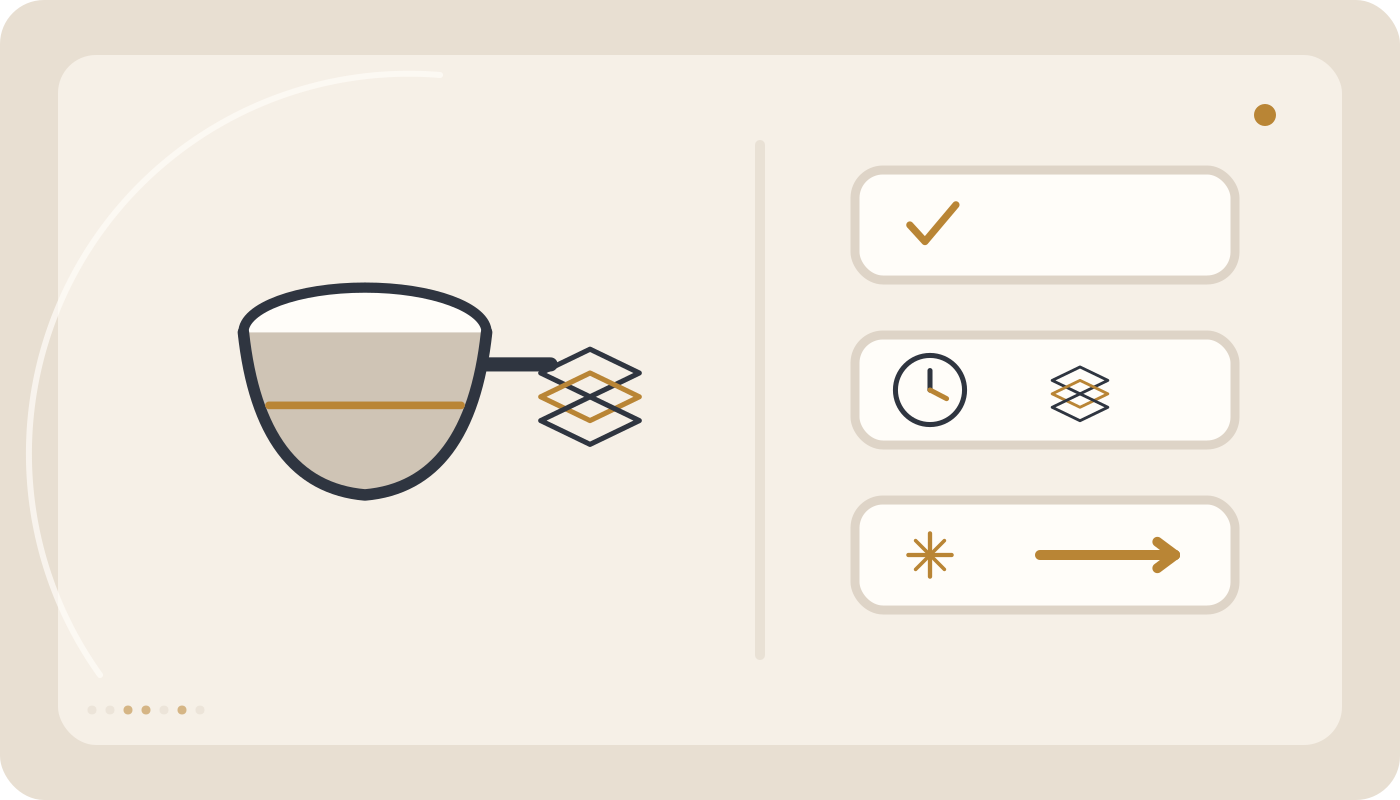
Stainless steel provides a durable cooking surface but spreads heat relatively slowly. Aluminum inside the construction moves heat more rapidly from the hot center toward surrounding areas, reducing severe temperature differences. Real performance depends on core thickness, bonding quality, base flatness, and matching the cookware to the burner or cooking zone.
Quick comparison
How Does Multi-Layer Stainless-Steel and Aluminum Cookware Spread Heat?
In clad cookware, each metal serves a different function. Stainless steel typically provides a durable cooking surface, while aluminum inside the construction spreads heat more quickly across the vessel. A well-designed combination reduces severe temperature differences between the center and outer areas of the base, but real performance also depends on layer thickness, bonding quality, and whether the conductive core exists only in the base or continues through the sidewalls.
Quick answer: Stainless steel is durable but conducts heat relatively slowly. Aluminum conducts and spreads heat much faster. When an aluminum core is bonded between stainless layers, heat enters from the burner or cooking zone, spreads laterally through the aluminum, and then reaches the food through the inner stainless surface. Better layer thickness and bonding generally produce more predictable heat distribution and fewer severe hot spots.
What does each layer do?
| Layer | Main function | Practical benefit |
|---|---|---|
| Inner stainless steel | Food-contact surface and mechanical durability | Durability and easier maintenance |
| Aluminum core | Faster lateral heat spreading | Reduced hot spots and improved uniformity |
| Outer stainless steel | Structural protection and exterior durability | Can also provide magnetic induction compatibility when designed appropriately |
| Bond between layers | Continuous thermal path | More stable thermal behavior |
1. Why not make the cookware only from stainless steel?
Stainless steel is durable and useful as a cooking surface, but its thermal conductivity is much lower than aluminum. Heat can remain more concentrated near the burner contact area.
2. Why place aluminum between stainless layers?
Aluminum moves heat laterally much faster. Encapsulating it allows cookware to use that thermal advantage while retaining a stainless food-contact surface.
3. Where does heat enter the cookware?
On gas, most energy initially reaches the part of the base exposed to flame. Electric and induction zones also deliver energy within a defined base area.
4. The aluminum core spreads heat outward
As the central area warms, aluminum moves heat toward neighboring regions faster than stainless steel alone.
5. What is a hot spot?
A hot spot is an area that becomes significantly hotter than surrounding regions, increasing the chance of local burning.
6. Clad construction can reduce hot spots
A suitable conductive core spreads energy across a wider area before it reaches the food.
7. Aluminum-core thickness matters
A very thin aluminum layer behaves differently from a more substantial core. The amount of conductive material affects heat spreading.
8. Thicker is not automatically better for every task
Greater thickness increases thermal mass but also weight and warm-up time. Good design balances responsiveness and heat retention.
9. Layer bonding is critical
Poor bonding interrupts the thermal path between materials and can reduce performance.
10. Base separation is not normal
A bulged, loose, blistered, or separating base needs inspection rather than being treated as normal thermal behavior.
11. Disc-base and fully clad cookware are different
Some cookware has a multi-layer disc attached only to the base, while other designs continue the conductive core into the sidewalls.
12. A good disc base is sufficient for many everyday tasks
Because most heat enters through the base, a well-designed disc can perform effectively for boiling, stews, and liquid-based cooking.
13. Fully clad walls can spread heat upward
When the conductive core continues through the sidewalls, heat can move more effectively into the sides of the vessel.
14. Hotter sidewalls are not always an advantage
They can help some sauces but may also dry residue on the walls in other cooking methods.
15. What does thermal responsiveness mean?
It describes how quickly cookware changes temperature when burner power is increased or reduced.
16. Aluminum improves responsiveness
An aluminum core generally transfers burner changes to the cooking surface more quickly.
17. More mass retains more heat
Heavier, thicker cookware tends to lose less surface temperature when cold food is added, but it also heats and cools more slowly.
18. Lighter cookware responds faster
A lighter pan may change temperature quickly but can experience a larger temperature drop when loaded with cold food.
19. Weight alone is not a quality measure
Weight must be considered together with materials, thickness, bonding, and intended use.
20. Why does the center of some pans burn food first?
A concentrated burner or weak heat-spreading construction can make the center much hotter than surrounding areas.
21. Burner size still matters
Even excellent clad cookware cannot fully compensate for a severely mismatched burner.
22. Oversized gas flames waste energy
Flames that climb beyond the base can overheat sidewalls and handles.
23. The magnetic outer layer has a separate role on induction
In some constructions, the exterior stainless layer is magnetic so the cooktop can deliver energy into the vessel.
24. Magnetic coupling and heat spreading are different jobs
Magnetic stainless interacts with induction, while aluminum mainly spreads heat. The functions complement one another.
25. Does the aluminum core touch food?
In properly clad cookware, the aluminum core is enclosed and the food-contact surface is defined by the inner layer.
26. Visible layers at the rim are not automatically a defect
Some clad designs expose the cross section at the rim. What matters is stable construction without layer separation.
27. A warped base disrupts heat transfer
A deformed base loses uniform contact with a flat cooktop and can perform less consistently.
28. Thermal shock can stress the base
Moving a very hot vessel directly under very cold water increases differential expansion between materials.
29. Different metals expand differently
Clad-cookware engineering must account for the different expansion behavior of stainless steel and aluminum.
30. Manufacturing quality shows over repeated heating cycles
Cookware should tolerate everyday heating and cooling without abnormal delamination or deformation.
31. Clad cookware still needs controlled preheating
Better heat spreading does not justify prolonged empty heating at extreme power.
32. Smoking oil still indicates excessive heat
A conductive pan may bring the entire surface to high temperature quickly, so oil behavior remains a useful warning.
33. Sauces benefit from more uniform heat
Thick sauces and burn-sensitive foods benefit from reduced localized overheating.
34. Frying also depends on heat retention
When cold food enters a pan, adequate thermal mass helps limit the temperature drop.
35. Differences can feel smaller when boiling large amounts of water
Liquid itself redistributes heat, so cookware design may be less noticeable than during dry or low-liquid cooking.
36. Low-moisture cooking reveals heat distribution more clearly
Searing, sauteing, and thick sauces have more direct contact with the base.
37. Heat spreading is not the same as nonstick performance
A stainless clad pan can distribute heat very well while still requiring proper technique to prevent food sticking.
38. Multi-layer construction does not imply a nonstick coating
Layer count describes structure and thermal behavior, not surface coating.
39. More layers do not automatically mean better performance
Three well-designed layers can outperform a higher number of very thin or poorly bonded layers.
40. Material quality matters more than marketing layer count
Material, thickness, and continuity of each layer provide more useful information than layer number alone.
41. What does a very thick base do?
It can stabilize temperature and reduce gradients, but it increases weight and slows response.
42. What does a very thin base do?
It heats quickly but can be more sensitive to concentrated burners and uneven heating.
43. What should you inspect when evaluating cookware?
- Inner-layer material
- Presence of a conductive core
- Overall base thickness
- Base flatness
- Uniform layer bonding
- Cooktop compatibility
- Weight appropriate for intended use
44. A simple real-world uniformity check
There is no need to overheat an empty pan. During normal cooking, observe whether food repeatedly burns in the same small area or whether the surface behaves relatively consistently when burner size is appropriate.
45. What do heat stains tell you?
Blue or gold heat tint indicates that the stainless surface reached a relatively high temperature, but it does not directly reveal aluminum-core quality.
46. Do not confuse layer separation with staining
Bulging, looseness, gaps at bonded areas, or local deformation can indicate a structural issue and deserve inspection.
47. How should a good multi-layer base behave?
| Behavior | Interpretation |
|---|---|
| Relatively uniform warming | Useful heat spreading |
| Controlled temperature drop when food is added | Adequate thermal mass |
| Predictable response when power is reduced | Controllable thermal behavior |
| Center is always much hotter than outer areas | Burner match, thickness, or heat spreading may need review |
| Base is warped or separating | Possible structural problem |
48. What should you ask before buying?
- What is the inner layer made from?
- What material is used for the conductive core?
- Is the clad construction only in the base or throughout the sidewalls?
- What is the overall base or wall thickness?
- What cooktop is the exterior layer designed for?
- Is the cookware induction compatible?
Common mistakes
- Assuming more layers always means better cookware
- Judging quality by weight alone
- Ignoring aluminum-core thickness
- Assuming stainless steel alone is the best heat spreader
- Using a severely mismatched burner and blaming the cookware
- Overheating empty cookware to test quality
- Quenching very hot cookware with cold water
- Confusing multi-layer construction with nonstick coating
- Ignoring base warping or delamination
- Trusting a multi-layer claim without knowing material and thickness
Conclusion
Stainless steel and aluminum are combined because each solves a different problem. Stainless provides a durable cooking surface, while aluminum spreads heat faster across the base and, in some designs, the sidewalls. Real performance depends not only on layer count but also on core thickness, bonding quality, base flatness, and correct burner or cooking-zone size.
Common mistakes
Change only one variable at a time while diagnosing.
- Do not assume more layers always means better cookware.
- Do not judge quality by weight alone.
- Do not ignore aluminum-core thickness.
- Do not assume stainless steel is the best heat conductor.
- Do not use severely undersized or oversized burners.
- Do not overheat empty cookware to test quality.
- Do not quench very hot cookware with cold water.
- Do not confuse multi-layer construction with nonstick coating.
- Do not ignore warping or layer separation.
- Do not accept a multi-layer claim without material and thickness details.
Frequently asked questions
Why is cookware stainless steel on the inside but aluminum in the middle?
Stainless provides a durable food-contact surface, while aluminum spreads heat faster across the base.
Does clad cookware cook more evenly?
When conductive-core thickness and bonding are well designed, it can reduce severe temperature differences and hot spots.
What is the difference between a clad base and fully clad cookware?
A clad base contains the conductive core only in the bottom, while fully clad construction continues it through the sidewalls.
Are more layers always better?
No. Material choice, thickness, and bonding quality matter more than nominal layer count.
Why is some clad cookware heavy?
Greater material thickness increases thermal mass and heat retention but also slows response.
What if a clad base separates or bulges?
That is not normal behavior and the cookware structure should be inspected.