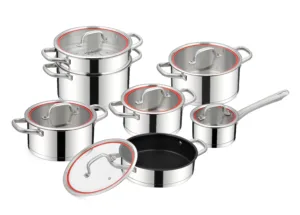
How to Prepare Stainless-Steel Cookware Before First Use
Prepare new stainless-steel cookware by removing packaging, inspecting the pot and lid, washing gently, rinsing thoroughly, drying completely, and starting with controlled heat.

Remove all packaging and labels, wash the pot and lid with warm water, mild detergent, and a soft sponge, rinse several times, and dry completely. Inspect the cooking surface, base, rim, and handles, then begin the first cooking session with moderate heat. Uncoated stainless does not need permanent cast-iron-style seasoning; coated interiors should follow their specific instructions.
Before you start
How to Prepare Stainless-Steel Cookware Before First Use
New stainless-steel cookware benefits from a simple but careful first-use routine. The goal is to remove packaging dust, fingerprints, possible manufacturing or polishing residue, inspect the surface and fittings, and prepare the cookware for food contact. For most uncoated stainless-steel cookware, warm water, mild dish detergent, a soft sponge, thorough rinsing, and complete drying are sufficient.
Quick answer: Remove all packaging and labels, wash the pot and lid with warm water, mild detergent, and a soft non-abrasive sponge, rinse several times, and dry completely. Inspect the cooking surface, rim, handles, lid, and base. If the cooking surface has a nonstick or ceramic coating, follow the coating-specific instructions instead of applying generic bare-stainless guidance. Ordinary uncoated stainless cookware does not require cast-iron-style seasoning before first use.
First-use checklist
| Stage | Action | Purpose |
|---|---|---|
| Unpack | Remove labels, films, and protective materials | Prevent packaging material from being heated |
| Inspect | Check surface, rim, handles, lid, and base | Identify damage before use |
| Wash | Warm water, mild detergent, soft sponge | Remove initial surface contamination |
| Rinse | Rinse several times with clean water | Remove detergent completely |
| Dry | Use a soft cloth or air dry | Reduce water spots and prepare for cooking |
1. Confirm whether the cooking surface is actually uncoated stainless steel
Some cookware has a stainless exterior but a nonstick or ceramic cooking surface. Coated cookware can require different cleaning tools, preheating limits, and first-use instructions.
2. Remove all packaging material
Take off plastic films, paper, foam, ties, and transport labels. Check the base and handle areas carefully.
3. Do not scrape labels with metal tools
Soften adhesive residue with warm water and mild detergent first. Knives, blades, and metal scrapers can mark polished or brushed finishes.
4. Inspect under good light
Look for deep scratches, sharp edges, unusual dents, loose handles, broken components, or obvious deformation before washing.
5. Check whether the base sits flat
Place the pot on a flat surface. Significant rocking or obvious base distortion should be investigated before cooking, especially on flat cooktops.
6. Handles should feel secure
Check the pot and lid handles by hand without applying excessive force. Noticeable looseness on new cookware should be addressed before the vessel is filled with hot food.
7. Test lid fit
The lid should sit normally without unusual binding. Inspect a glass lid for cracks, chipped edges, and secure handle attachment.
8. Use warm water for the first wash
Warm water is sufficient to remove normal packaging dust, fingerprints, and surface residue.
9. A small amount of mild detergent is enough
Using excessive detergent does not necessarily improve cleaning and makes thorough rinsing harder.
10. Use a soft sponge or cloth
Clean the cooking surface, sidewalls, rim, exterior, and base with a non-abrasive tool.
11. Steel wool is unnecessary for first-use cleaning
Stainless steel is durable, but metal scouring can mark the finish. New cookware should not require aggressive abrasion to become clean.
12. Clean under rims and around handle joints
Packaging dust can collect around seams, rivets, and handle attachments. Use a soft sponge or brush.
13. Wash the lid separately
Clean the lid rim, handle, and any steam vent. Protect glass lids from impact.
14. Rinse thoroughly
Rinse the pot and lid several times until no detergent foam or fragrance remains.
15. Dry completely
Water minerals can leave pale spots after drying. Use a soft cloth or allow the cookware to dry fully in a clean environment.
16. Water spots do not necessarily mean a stainless-steel defect
White marks after drying can be mineral deposits from water rather than a material problem.
17. Do you need to boil water in a new stainless pot?
It is not a universal requirement. Thorough washing is normally sufficient. If the product instructions recommend an initial water-boil step, follow those specific instructions.
18. Does stainless cookware need seasoning?
Ordinary uncoated stainless steel does not require a permanent oil seasoning layer like cast iron. Oil used during cooking is a separate issue.
19. Avoid prolonged empty heating
Do not leave an empty new pot over high heat for a long period. Excessive heating can discolor stainless surfaces and stress handles or attached components.
20. Match flame size to the base
On gas burners, flames should generally remain under the base rather than climbing the sidewalls.
21. Begin the first cooking session with moderate heat
Learn how the cookware behaves on your stove. Start with moderate heat and adjust only as necessary.
22. Do not severely overheat before adding food
Some cooking methods use controlled preheating, but prolonged extreme heating is not necessary. Heat management and food sticking are better handled as a separate topic.
23. Avoid leaving dry salt on a very hot base
When cooking in water, add and dissolve salt in the liquid rather than leaving concentrated salt crystals on one hot area for an extended period.
24. Do not store strongly acidic or salty food in the pot for unnecessarily long periods
Stainless cookware is widely useful for cooking, but finished food is better transferred to a suitable storage container for prolonged storage.
25. Let the pot cool somewhat before washing
Do not move a very hot pot directly under very cold water. Severe temperature changes can stress bonded bases and may contribute to deformation in some cookware.
26. If food sticks, do not attack the surface with abrasion
Let the pot cool, add warm water, and soften the residue. Food sticking and temperature control deserve their own guide.
27. If a cloth turns dark when wiping the surface, investigate separately
Dark transfer can have several causes, including polishing or manufacturing residue and ordinary surface contamination. If it continues after correct washing, identify the cause rather than scrubbing aggressively.
28. Use a dishwasher only when the manufacturer approves it
Although many stainless products are dishwasher-compatible, handles, lids, exterior finishes, or composite parts may have different limitations.
29. Coated cookware needs its own instructions
If the cooking surface is nonstick, ceramic, or patterned, cleaning tools, preheating, oil use, and maximum temperatures should follow the coating instructions.
30. Take extra care with bonded or multi-layer bases
Avoid severe impacts, prolonged empty high heat, and abrupt cooling. These habits help protect base shape and bonding.
31. For induction use, check compatibility
A stainless appearance alone does not guarantee induction compatibility. Look for the product marking or specification and match the base size to the cooking zone.
32. A practical first-day routine
- Remove all packaging and labels.
- Inspect the surface, base, handles, and lid.
- Wash the pot and lid with warm water and mild detergent.
- Use a soft sponge on all surfaces.
- Rinse several times and dry fully.
- Start the first cooking session on a suitable burner with moderate heat.
- After cooking, allow some cooling before normal washing.
33. What is not normal before first use?
| Sign | Action |
|---|---|
| Sharp edge or metal burr | Do not use until inspected |
| Clearly loose handle | Correct or inspect before use |
| Cracked glass lid | Do not use the lid |
| Severely warped base | Inspect before use |
| Persistent dark transfer after correct repeated washing | Investigate the surface separately |
| Peeling or separating inner layer | Stop use until the surface structure is identified |
Common first-use mistakes
- Cooking without washing the new pot first
- Heating packaging film or labels left on the cookware
- Using steel wool on a new surface
- Prolonged empty heating over high heat
- Using flames that climb the sidewalls
- Quenching a very hot pot with cold water
- Assuming stainless steel requires cast-iron-style seasoning
- Applying bare-stainless instructions to a nonstick or ceramic surface
- Ignoring loose handles or a cracked lid
- Aggressively scrubbing unexplained dark residue instead of identifying it
Conclusion
Preparing new stainless-steel cookware is simple: inspect, wash gently, rinse thoroughly, dry completely, and begin cooking with controlled heat. Uncoated stainless steel normally does not need complicated conditioning or harsh chemicals. If the inner surface is coated, follow that coating’s instructions. More specific questions such as food sticking or dark residue on a wiping cloth should be diagnosed separately.
Common mistakes
Change only one variable at a time while diagnosing.
- Do not cook in new cookware before initial washing.
- Do not heat packaging film or labels left on the pot.
- Do not use steel wool for the first wash.
- Do not heat an empty pot for a long time over high heat.
- Do not let gas flames climb the sidewalls.
- Do not quench a very hot pot with cold water.
- Do not assume stainless requires permanent cast-iron-style seasoning.
- Do not apply bare-stainless guidance to nonstick or ceramic interiors.
- Do not ignore loose handles or a cracked lid.
- Do not aggressively scrub unexplained dark residue.
Frequently asked questions
Should new stainless-steel cookware be washed before use?
Yes. Warm water, mild detergent, and a soft sponge are appropriate for removing packaging dust and normal surface residue.
Does stainless cookware need seasoning before first use?
Ordinary uncoated stainless steel does not need a permanent seasoning layer like cast iron; cooking oil use is a separate technique.
Do I need to boil water in the pot before first use?
It is not a universal requirement. Follow the manufacturer if an initial boil is specifically recommended; otherwise thorough washing is normally sufficient.
Can I use steel wool for the first wash?
It is better not to. A soft sponge should be enough for new cookware and is less likely to mark the finish.
What if the cooking surface is nonstick or ceramic?
Follow the coating-specific instructions instead of treating it as bare stainless steel.
What if a cloth turns dark when wiping the stainless surface?
If it continues after proper washing, investigate the surface cause separately rather than scrubbing aggressively.