What Cookware Size Is Right for Your Family?
Choose cookware size from household size, actual capacity, cooking style, batch volume, base diameter, and cooktop dimensions rather than people count alone.
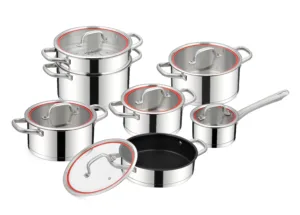
For one or two people, 16 to 20 centimeter pots and a 20 to 24 centimeter frying pan are useful starting points. For three or four people, 20 to 24 centimeter pots and a 24 to 26 centimeter frying pan often work well. For five or six people, 24 to 28 centimeter pots and a 26 to 28 centimeter frying pan provide more room. Cooking style, batch volume, vessel height, capacity, and cooktop size matter more than household count alone.
What Cookware Size Is Right for Your Family?
Cookware size should not be selected from household size alone. Cooking style, batch size, meal-prep habits, burner or cooking-zone diameter, storage space, and the type of food all influence the right choice. A vessel that is too small becomes crowded or prone to boiling over, while unnecessarily large cookware can be heavy, inefficient, and poorly matched to the cooktop.
Quick answer: For one or two people, small-to-medium pots and a roughly 20 to 24 centimeter frying pan are useful starting points. For three or four people, pots around 20 to 24 centimeters and a 24 to 26 centimeter frying pan often cover daily needs. For five or six people, 24 to 28 centimeter pots and a 26 to 28 centimeter frying pan are more flexible. Larger households or batch cooks may need pots above 28 centimeters. These are approximate starting points; actual capacity and cooking style matter more than diameter alone.
Quick guide by household size
| Household | Everyday pot | Everyday frying pan | Larger batch vessel |
|---|---|---|---|
| 1 to 2 people | 16 to 20 cm | 20 to 24 cm | About 22 cm |
| 3 to 4 people | 20 to 24 cm | 24 to 26 cm | About 26 cm |
| 5 to 6 people | 24 to 28 cm | 26 to 28 cm | About 28 to 30 cm |
| 7 or more | 28 cm and above | 28 to 32 cm | Choose by actual batch volume |
This table is only a starting point. Rice, soup, stews, frying, and pasta can require different vessel shapes and capacities.
1. What does cookware diameter actually measure?
Nominal size is often based on the upper opening, while wall shape and base diameter can differ. Two pots with the same nominal diameter can therefore have different capacities.
2. Capacity can matter more than diameter
For soups, stews, pasta, and other liquid-heavy foods, stated volume is often more useful than diameter alone.
3. Do not fill to nominal capacity during cooking
Leave headroom for stirring, boiling, expansion, and safe handling.
4. A one-person household may still need a large pot
Batch cooking for several meals changes the required vessel size even when only one person is eating.
5. Large households still need small cookware
Small pots are useful for sauces, reheating, milk, eggs, and small components.
6. A practical cookware set uses complementary sizes
Choose sizes that serve clearly different jobs instead of several nearly identical diameters.
7. A useful combination for one or two people
A 16 to 18 centimeter small pot, a roughly 20 centimeter medium pot, and a 20 to 24 centimeter frying pan cover many daily tasks.
8. A useful combination for three or four people
Pots around 20 and 24 centimeters plus a 24 to 26 centimeter frying pan provide a balanced starting set.
9. A useful combination for five or six people
Pots around 24 and 28 centimeters plus a 26 to 28 centimeter frying pan provide more room, with a larger pot useful for batch cooking.
10. Larger families should focus on actual capacity
At larger volumes, vessel height and liter capacity become increasingly important.
11. Wide shallow and tall narrow pots behave differently
A wide pot promotes evaporation and offers more surface area, while a taller vessel is useful for soups, water, pasta, and large liquid volumes.
12. Rice size depends on more than serving count
Rice variety, expansion, cooking method, and desired crust all influence the useful diameter and height.
13. Rice needs headroom
The vessel should not start so full that expansion and handling become difficult.
14. Very wide cookware is not always best for stews
A very wide surface can increase evaporation during long cooking.
15. Taller pots are useful for soups
More liquid and vigorous simmering benefit from additional sidewall height and headroom.
16. Pasta requires liquid space
The pot should allow water and pasta to move without excessive boil-over risk.
17. Frying pans are chosen mainly by usable surface area
A larger base allows food to sit in a single layer rather than piling up.
18. Overcrowded pans steam food
Too much food traps moisture and reduces browning.
19. A very large pan on a small burner is also a mismatch
The center can become much hotter than the edges when the heat source is too small.
20. Match base diameter to the cooktop
The main base area should reasonably match the burner or cooking zone.
21. Effective base diameter matters on induction
Some induction zones require a minimum detectable magnetic base size.
22. Larger cookware needs more energy to warm up
This is especially noticeable with thick or multi-layer construction.
23. Cookware that is too small boils over more easily
Food close to the rim leaves little room for bubbling or stirring.
24. Oversized cookware can make small meals harder to control
A large exposed surface can increase evaporation when the food volume is low.
25. Consider the weight when full
A large pot filled with water or food can be much heavier than it feels when empty.
26. Handles matter more as size increases
Larger cookware needs secure, comfortable handles for controlled lifting.
27. Do not forget sink and cabinet dimensions
Cookware that is difficult to wash or store may be used less often.
28. Lids also consume storage space
Plan where lids will be stored before buying a large set.
29. A larger set is not automatically better value
Unused pieces create cost and storage burden without practical benefit.
30. Closely spaced sizes may be redundant
Several pots with minimal diameter differences add little value unless they serve distinct jobs.
31. Start by listing your three most common foods
Your cookware mix should reflect what you actually cook most often.
32. Daily cooking and batch cooking need different sizes
Fresh single-meal cooking generally uses smaller vessels than preparing two or three meals at once.
33. Regular entertaining changes the calculation
A larger reserve pot and pan make sense when guests are frequent.
34. Not every daily vessel needs to be party size
It is usually better to keep one or two larger supplemental pieces instead of oversizing the entire set.
35. Small cookware is efficient for small quantities
It is easier to control and requires less space for reheating or small recipes.
36. Choose frying-pan size by the food footprint
If you usually cook two small portions, an oversized pan may be unnecessary. If you routinely cook multiple pieces at once, more surface area helps.
37. Different foods need different headroom
Boiling soup, expanding rice, and deep frying all require different amounts of free space above the food.
38. Deep frying requires generous safety headroom
Hot oil should never approach the rim of the vessel.
39. Pressure cookers follow different fill rules
Pressure cookware has specific maximum fill limits and should not be sized by ordinary-pot logic alone.
40. The same nominal size can feel different between brands
Wall slope, height, and base shape change usable capacity and cooking area.
41. What to inspect in person
- Rim diameter
- Actual base diameter
- Wall height
- Stated capacity
- Empty weight
- Handle size and shape
- Match with your home cooktop zones
42. What matters when buying online?
If a listing only says size 24, look for capacity, height, and base diameter before deciding what the vessel can actually handle.
43. Selection by cooking style
| Cooking pattern | More suitable choice |
|---|---|
| Small daily meals | Small and medium pots |
| Batch cooking | One larger supplemental pot |
| Frequent searing and sauteing | Frying pan with more usable base area |
| Soups and large liquid dishes | Taller higher-capacity pot |
| Regular entertaining | One or two additional large sizes |
| Small kitchen | Complementary sizes with minimal overlap |
44. A simple way to build a personal cookware set
- Identify the usual number of people eating.
- List your three most common dishes.
- Decide whether you routinely cook extra meals.
- Measure burner or cooking-zone diameter.
- Choose a small and medium pot, plus a large pot only when needed.
- Choose frying-pan size by actual food surface area.
- Before buying similar sizes, define a separate job for each one.
45. A balanced combination for many homes
For an average household, one small pot, one medium daily pot, one larger batch vessel, and one medium-to-large frying pan are often more useful than many closely spaced sizes.
46. When should you choose a larger size?
- You cook for several meals at once.
- You frequently make large soups or stews.
- You entertain regularly.
- Your food expands significantly during cooking.
- Your current frying pan is consistently overcrowded.
47. When should you choose a smaller size?
- Your food quantity is usually small.
- Your current large pot is mostly empty.
- Your cooktop has small cooking zones.
- A large full vessel is uncomfortable to lift.
- Washing and storage space are limited.
48. The right size should feel practical
The best cookware is not automatically the biggest or heaviest. It is the size that matches your real food volume, cooktop, handling ability, and kitchen space.
Common mistakes
- Choosing size only from household count
- Ignoring actual capacity and wall height
- Filling pots too close to the rim
- Using a small frying pan for too much food
- Using an oversized pan on a small burner
- Ignoring the weight of full cookware
- Buying a very large set only because it contains more pieces
- Buying several almost-identical sizes without distinct uses
- Ignoring cabinet and sink space
- Assuming rim diameter equals base diameter
Conclusion
The right cookware size comes from household size, food type, batch volume, and cooktop dimensions together. For most kitchens, a small number of complementary sizes is more useful than many overlapping pieces. Consider diameter alongside capacity, height, and base size, and choose cookware that is neither consistently overcrowded nor mostly empty.
Common mistakes
Change only one variable at a time while diagnosing.
- Do not choose cookware size from household count alone.
- Do not fill cookware close to the rim.
- Do not assume rim diameter equals base diameter.
- Do not overcrowd a small frying pan.
- Do not use an oversized pan on a small burner.
- Do not ignore full cookware weight.
- Do not focus only on the number of pieces in a set.
- Do not buy several nearly identical sizes without distinct uses.
- Do not ignore cabinet and sink space.
- Do not size every daily vessel for your largest annual gathering.
Frequently asked questions
What pot size is good for a family of four?
Around 20 to 24 centimeters is a useful starting range for many daily tasks, but food type and batch size remain more important.
What frying-pan size is good for four people?
Around 24 to 26 centimeters works for many uses; choose more surface area if you often cook several portions at once.
Is capacity more important than diameter?
For many liquid-based dishes, capacity and height matter more, while diameter matters for cooktop matching and usable cooking surface.
Why do two pots with the same size hold different volumes?
Wall height, slope, and base geometry can differ.
What if I batch cook several meals?
Choose one larger supplemental pot so extra food fits without overcrowding.
Is a cookware set with more pieces always better?
No. A smaller set of complementary frequently used sizes can provide better value.