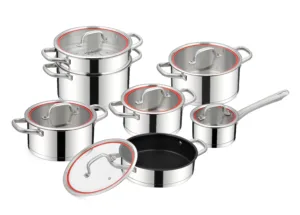
What Are White Spots on Stainless Steel and How Do You Remove Them?
White chalky marks on stainless cookware are usually mineral deposits from water. Learn what causes them, how to remove them safely, and how to prevent recurrence.

White spots on stainless steel usually come from water minerals left behind as droplets dry. Start with warm water, mild detergent, and a soft sponge, then dry completely. If spots remain on uncoated stainless steel, use only a manufacturer-approved mild acidic method such as diluted white vinegar where permitted. Rinse several times and dry immediately.
Before you start
What Are White Spots on Stainless Steel and How Do You Remove Them?
White, chalky spots or pale rings on stainless-steel cookware usually come from minerals in water, especially calcium and magnesium, left behind after droplets dry or water evaporates. These marks are mainly a surface and appearance issue and can often be removed with gentle washing or a controlled mild acidic method on uncoated stainless steel.
Quick answer: First wash the cookware with warm water, mild detergent, and a soft sponge, then dry completely. If a white mark remains and the surface is bare stainless steel, use only a manufacturer-approved mild descaling method, such as diluted white vinegar where permitted. Wash again with mild detergent, rinse several times, and dry immediately. Do not confuse white mineral deposits with rust, rainbow heat tint, or a flaking surface.
What white deposits usually look like
| Appearance | Likely cause | Action |
|---|---|---|
| White dots after water droplets dry | Water minerals | Wash and dry promptly |
| White ring at a former water level | Mineral concentration during evaporation | Use a mild compatible descaling method |
| Thin chalky film | Hard water or repeated boiling | Controlled descaling |
| Blue or purple coloration | Heat tint | Treat as a separate issue |
| Black transfer to a cloth | Surface residue or soot | Diagnose separately |
| Rough brown spot | Possible corrosion or iron contamination | Do not assume it is a water deposit |
1. White spots usually come from water, not the stainless steel itself
Tap water contains dissolved minerals. When the water evaporates, some of those minerals remain on the surface.
2. Hard water leaves more visible deposits
Areas with higher calcium and magnesium levels tend to produce more white spotting.
3. White marks after washing are common
If cookware is left wet and droplets dry naturally, pale mineral rings can form even on healthy stainless steel.
4. Prompt drying is the simplest prevention
After rinsing, dry the cookware with a clean soft cloth to reduce mineral spotting.
5. White deposits on the base are common after boiling water
As water boils away, dissolved minerals become more concentrated and can settle on the bottom.
6. A white ring on the sidewall can mark the former water level
If water stands or evaporates in the pot, mineral deposits can form where the waterline was located.
7. Start with ordinary washing
Warm water, a small amount of mild detergent, and a soft sponge remove many fresh deposits.
8. Avoid aggressive scrubbing
Mineral deposits usually do not require steel wool or heavy abrasion, which can mark the finish.
9. Identify the surface before using acid
Confirm that the interior is truly uncoated stainless steel. Coated or ceramic cookware should follow its own care instructions.
10. Diluted white vinegar can help on some bare stainless surfaces
When permitted by the manufacturer, diluted white vinegar can dissolve some calcium-based deposits.
11. Short contact is better than prolonged soaking
A few minutes is usually enough for ordinary water spots. Wash and rinse thoroughly afterward.
12. Do not apply acidic cleaner to a very hot pan
Allow the cookware to cool to a safe temperature before cleaning.
13. Never mix acidic cleaner with bleach
This combination can release dangerous gas. Use cleaning products separately and exactly as directed.
14. Strong bleach is unnecessary for mineral deposits
The problem is mineral residue, not something that requires aggressive bleaching.
15. Baking soda is not always the best tool for white mineral deposits
Baking soda is mildly alkaline and slightly abrasive. A compatible mild acidic method is often more logical for mineral deposits.
16. Do not scrub with dry baking soda under heavy pressure
Dry powder can mark polished stainless surfaces.
17. Thorough rinsing matters after descaling
Remove all cleaning solution from the food-contact surface before reuse.
18. Dry immediately after rinsing
If fresh water droplets are allowed to dry again, new mineral spots can form.
19. If spots mainly appear after dishwasher use
Water hardness, detergent, rinse aid, and drying conditions may all contribute. Confirm that the cookware is dishwasher-compatible.
20. Salt can create its own surface marks
Dry salt crystals left concentrated on a wet or very hot surface can create localized marks. Dissolve and distribute salt in cooking liquid.
21. Do not assume every rough white spot is mineral scale
If the surface is pitted, sharply rough, or damaged, the issue may be more than a deposit.
22. Mineral scale should mostly sit on the surface
It should respond to suitable cleaning. A true change in the metal texture needs different diagnosis.
23. Rainbow heat tint is different
Blue, purple, and gold colors are generally heat-related oxide changes rather than mineral deposits.
24. Black cloth transfer is also different
Gray or black transferable residue suggests polishing residue, soot, or contamination rather than hard-water scale.
25. Rust is usually not white
Iron-related corrosion more often appears brown or orange. A smooth white haze is more consistent with mineral residue.
26. The exterior base can also develop water spots
If wet cookware is left to air dry, white mineral deposits can appear underneath as well.
27. Polished stainless shows spots more clearly
Visible spotting can be more obvious on a bright polished finish without indicating greater damage.
28. Follow the grain on brushed stainless
Wipe along the visible grain with a soft cloth to preserve a uniform appearance.
29. In hard-water areas, prevention matters more
Prompt drying, complete rinsing, and occasional mild descaling can prevent thick buildup.
30. Repeated boiling concentrates minerals
Every evaporation cycle increases mineral concentration in the remaining water.
31. Use an appropriate amount of water for cooking
Long boiling with very little water or near-complete evaporation can concentrate deposits on the base.
32. Leaving food overnight can complicate diagnosis
Food residue, salt, and water minerals can combine. Wash and dry the cookware after use.
33. Repeat a mild process instead of increasing aggression
Two gentle cleaning cycles are better than one harsh abrasive session.
34. If the mark does not change at all
Consider whether it is actually heat tint, scratching, corrosion, or a finish change rather than mineral scale.
35. If white powder is coming off
Some mineral deposits can be powdery, but true flaking or material separation from the cookware surface deserves inspection.
36. Step-by-step white-spot removal
- Allow very hot cookware to cool.
- Wash with warm water, mild detergent, and a soft sponge.
- Rinse and dry completely.
- If spots remain, confirm the surface is uncoated stainless steel.
- When permitted, apply a small amount of diluted white vinegar or compatible mineral-deposit cleaner.
- Wait a few minutes and wipe gently.
- Wash again with mild detergent.
- Rinse several times and dry immediately.
37. Quick appearance guide
| Appearance | Most likely cause |
|---|---|
| White and chalky | Water minerals |
| White ring at a fixed height | Former water level and evaporation |
| Blue, purple, or gold | Heat tint |
| Black transferable residue | Surface contamination or soot |
| Brown rough spot | Possible corrosion or iron contamination |
| Actual flaking | Surface or coating damage |
38. When is descaling not enough?
If white marks appear together with pitting, cracking, severe roughness, flaking, or material separation, the issue is more than ordinary water minerals and the cookware should be inspected.
Common mistakes
- Leaving wet cookware to air dry with droplets on the surface
- Scrubbing white deposits with steel wool
- Using strong bleach for hard-water scale
- Mixing vinegar with bleach
- Using acidic cleaners on coated cookware without checking instructions
- Using dry abrasive powder with heavy pressure
- Confusing white deposits with rainbow heat tint
- Confusing white deposits with brown corrosion
- Ignoring real pitting or flaking
- Cleaning the cookware and then leaving it wet again
Conclusion
White marks on stainless cookware are most often mineral deposits left by water. Regular washing, thorough rinsing, and prompt drying are the best prevention. For remaining deposits on uncoated stainless steel, a short mild acidic cleaning method can be used when the manufacturer allows it. If the surface is pitted, severely rough, or flaking, do not assume the problem is only water scale.
Common mistakes
Change only one variable at a time while diagnosing.
- Do not leave wet cookware covered in drying water spots.
- Do not scrub white scale with steel wool.
- Do not use strong bleach for mineral deposits.
- Do not mix vinegar with bleach.
- Do not use acidic cleaners on coated cookware without checking instructions.
- Do not scrub with dry abrasive powder under heavy pressure.
- Do not confuse white deposits with rainbow heat tint.
- Do not confuse white deposits with brown corrosion.
- Do not ignore real pitting or flaking.
- Do not clean the cookware and then leave it wet again.
Frequently asked questions
Why do white spots appear on stainless cookware?
They usually come from calcium, magnesium, and other dissolved water minerals left behind after evaporation.
Do white spots mean the stainless steel is damaged?
Usually not. If the surface is smooth and the marks respond to appropriate cleaning, they are likely mineral deposits.
How do I remove white spots?
Start with ordinary washing. On bare stainless steel, use only a manufacturer-approved mild acidic method if needed.
Is vinegar suitable for white mineral deposits?
It can help on some uncoated stainless cookware when used briefly, followed by thorough rinsing, if the product instructions allow it.
How do I prevent white spots from returning?
Dry cookware promptly after rinsing and use occasional mild descaling in hard-water areas.
When should I be concerned about a white mark?
If it is accompanied by pitting, severe roughness, flaking, or material separation, do not assume it is only mineral scale.