Tea Maker, Electric Kettle, or Kettle-and-Teapot Set: Which Is Right for You?
Choose an electric kettle for quick hot water, a tea maker for frequent tea preparation, or a kettle-and-teapot set for traditional brewing by comparing routine, capacity, space, and features.
For quick hot water and varied use, choose an electric kettle; for frequent tea preparation and temperature holding, consider a tea maker; for traditional brewing and manual control, consider a kettle-and-teapot set.
Tea Maker, Electric Kettle, or Kettle-and-Teapot Set: Which Is Right for You?
All three options provide hot water, but they offer different daily experiences. An electric kettle focuses on quick, simple water heating; a tea maker integrates boiling, brewing, and often keeping tea warm; and a kettle-and-teapot set suits users who prefer a more traditional, manually controlled brewing method.
Quick answer: choose an electric kettle if you mainly need hot water quickly for different drinks. Choose a tea maker if tea is prepared frequently and keeping it warm matters. Choose a kettle-and-teapot set if you prefer traditional brewing, simplicity, and more manual control.
Start with your actual routine
Before comparing appearance or feature counts, consider how you use hot water: how often do you drink tea, do you need only boiling water or a ready teapot, should the drink remain warm, and how much counter space is available?
Who is an electric kettle best for?
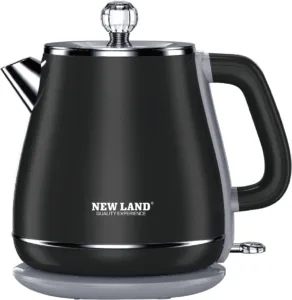
An electric kettle has a focused job: heating and boiling water. It is particularly practical when hot water is used for tea bags, infusions, instant coffee, or general kitchen tasks.
- Simple, quick operation
- Usually requires less counter space than a full tea-maker set
- Good for users who do not need a teapot ready all day
- Practical for smaller kitchens, offices, or rooms where appropriate
What is the limitation of an electric kettle?
By itself, it does not manage tea steeping or keep a separate teapot warm. Users who regularly serve several cups from one brewed pot may need an additional teapot and warming method.
Who is a tea maker best for?
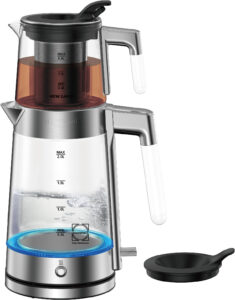
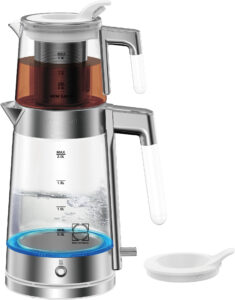
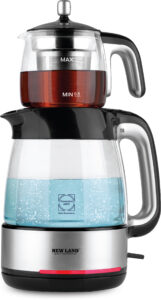
A tea maker is well suited to households or workplaces where tea is a regular part of the day. Combining a kettle and teapot, often with a keep-warm function, makes brewing and serving more integrated.
- Suitable for frequent tea consumption
- Kettle and teapot work as one coordinated set
- Keep-warm capability on equipped models
- Convenient for serving several people
Stacked or side-by-side tea maker?
Stacked designs typically place the teapot above the kettle and use less horizontal counter space. Side-by-side designs position the kettle and teapot separately on a base. The better choice depends on counter space, serving habits, and personal preference.
Who is a traditional kettle-and-teapot set best for?
If you enjoy traditional tea preparation and prefer to control heat and timing yourself, a kettle-and-teapot arrangement remains a logical option. It is generally more manual and less automated.
Quick comparison
| Criterion | Electric kettle | Tea maker | Kettle + teapot |
|---|---|---|---|
| Main purpose | Boiling water | Brewing and keeping tea warm | Traditional tea brewing |
| Quick access to hot water | Typically excellent | Good | Depends on heat source |
| Integrated teapot | No | Yes | Yes |
| Automatic keep-warm | Model dependent | Common on many models | Usually manual |
| Counter space | Usually lower | Usually higher | Design dependent |
| Manual control | Low to medium | Medium | Higher |
| Frequent tea drinking | Moderate | Very suitable | Suitable |
For a family that drinks tea frequently
A tea maker is often more convenient when several people drink tea at different times because the kettle and teapot remain together and an equipped model can maintain temperature for a period. Excessively long heat holding, however, can reduce tea quality.
For one or two light users
If you usually prepare only one or two drinks and do not need a brewed teapot available continuously, an electric kettle may be simpler and more compact.
For an office
For occasional hot water and varied drinks, an electric kettle is straightforward. Where several people drink tea repeatedly or hospitality is frequent, a tea maker can provide a more convenient workflow.
Higher wattage is not the only selection criterion
Power affects heating speed, but capacity, temperature control, automatic shut-off, boil-dry protection, kettle and teapot quality, ease of cleaning, and after-sales support also matter. Features should always be confirmed for the specific model.
Choose capacity according to real consumption
An oversized kettle is not necessarily beneficial for a light user, while a small unit may require constant refilling in a busy household. Match kettle and teapot capacities to the number of users and serving frequency.
Consider safety and usability
Compare features such as automatic shut-off, boil-dry protection, comfortable handles, safe lid operation, water-level indication, and base stability. Availability varies by model.
Which is easier to clean?
An electric kettle has fewer components and is generally simpler for routine cleaning. A tea maker also requires cleaning of the teapot, filter, and warming area. Cleaning a traditional kettle-and-teapot set depends on its materials and heat source.
Three simple buying scenarios
| Your routine | Suggested type | Why |
|---|---|---|
| “I just want boiling water quickly.” | Electric kettle | Simple, direct, and compact |
| “We always have tea at home.” | Tea maker | Kettle, teapot, and warming in one system |
| “I prefer traditional brewing and manual control.” | Kettle + teapot | Familiar process with more direct control |
Ask yourself these seven questions before buying
- How many times a day do I prepare tea or hot water?
- How many people normally use it?
- Do I need tea to remain warm?
- How much counter space is available?
- What teapot material do I prefer?
- How important is easy cleaning?
- Does the model provide the safety features and after-sales support I need?
Summary
There is no universal best choice. An electric kettle is ideal for simplicity and quick hot water, a tea maker suits frequent tea preparation and an integrated kettle-teapot workflow, and a kettle-and-teapot set suits users who prefer traditional brewing and manual control. Match the product to your actual capacity needs, available space, and daily habits before focusing on appearance or secondary features.
Choose from your real routine
A tea maker suits frequent tea drinkers who want brewing and keep-warm in one setup. An electric kettle is simpler when the main need is fast hot water. A traditional kettle-and-teapot setup suits users who prefer manual brewing on a separate heat source.
Do not buy on boiling speed alone
Capacity, cleaning access, counter space, keep-warm behavior, cable management, and teapot usability matter more over years of use than a small difference in boiling time.
Common mistakes
Change only one variable at a time while diagnosing.
- Do not choose based only on wattage.
- Do not assume a larger capacity is always better.
- Do not confuse keep-warm with continuous boiling.
- Do not ignore available counter space.
- Do not assume a safety feature is present without checking the specific model.
Frequently asked questions
Which is better for one or two people?
If you mainly need hot water and do not keep a teapot ready, an electric kettle is often simpler.
What is better for a family that drinks tea frequently?
A tea maker is often more convenient because it integrates the kettle, teapot, and commonly a keep-warm function.
Is a stacked or side-by-side tea maker better?
It depends on counter space and workflow; stacked models generally use less horizontal space.
Is higher wattage always better?
No. Wattage is only one factor alongside capacity, safety, temperature control, build quality, and cleaning.