How Can You Prevent Scale Buildup in Irons and Garment Steamers?
A practical guide to preventing mineral scale in irons and garment steamers, covering water choice, hardness, Self-Clean, Calc-Clean, anti-calc collectors, filters, and cartridges.
Use the water specified in the appliance manual, do not leave the tank full for long storage, avoid fragrance and unapproved chemicals, and service the Self-Clean, Calc-Clean, collector, filter, or cartridge system on schedule.
Before you start
How Can You Prevent Scale Buildup in Irons and Garment Steamers?
Mineral scale is a common cause of declining steam output, white particles, water spitting, and restricted internal passages. The correct solution is not automatically using distilled water or repeatedly pouring vinegar into the appliance. Effective prevention is built around three principles: use the water specified by the manufacturer, manage standing water correctly, and perform the appliance’s own anti-calc or descaling procedure on schedule.
Quick answer: Check the manual for the required water type, do not leave the reservoir full for long storage, never add fragrance or unapproved chemicals, perform Self-Clean/Calc-Clean or service the collector when instructed, and never introduce a descaling solution unless the manufacturer approves it.
What is scale?
Tap water contains dissolved minerals. As water is heated and evaporated, some minerals can remain as solid deposits on heaters, steam chambers, valves, and outlets. The rate depends on water hardness, temperature, water volume, and appliance design.
What is water hardness?
Hardness mainly reflects calcium and magnesium concentrations. Harder water generally has a greater tendency to form mineral deposits in heated equipment. Clear-looking water can still be hard.
Early signs of scale
- Gradually weaker steam.
- Uneven steam distribution.
- White particles.
- Water spitting with mineral debris.
- Abnormal behavior in some pumped systems.
- More passes needed for the same result.
Scale is not the same as rust
White or gray particles often indicate minerals. Repeated brown particles can have other causes, including contamination or corrosion, and should not automatically be treated as ordinary scale.
What water should you use?
There is no universal answer. Some appliances are designed for tap water; others have special instructions for very hard water, and some manufacturers advise against 100% distilled water. The manual for the exact model is the primary reference.
Is distilled water always best?
No. This is a common misconception. Some appliance designs specify tap water or a particular mixture. Do not assume pure distilled water is technically correct without checking the manual.
What about filtered water?
“Filtered” does not describe mineral content precisely. Carbon filtration, reverse osmosis, ion-exchange softening, and bottled water all produce different water chemistry.
Bottled water can still contain minerals
Mineral water may intentionally contain substantial dissolved minerals. For a steam appliance, mineral composition matters more than packaging.
Whole-house softened water
Ion-exchange softeners alter water chemistry, and some manufacturers place restrictions on softened water. Check the manual if your building uses a central softener.
Do not add these substances unless explicitly approved
- Vinegar.
- Citric acid.
- Kettle or coffee-machine descaler.
- Fragrance or essential oils.
- Fabric softener.
- Detergent.
- Scented ironing water.
Why can vinegar be a problem?
Acetic acid may be incompatible with certain seals, coatings, or internal components, and odor can remain in the steam path. A household remedy that works in one appliance is not automatically safe in another.
Is citric acid safer?
Not universally. Concentration and component materials matter. Use it only when the manufacturer specifies an approved method.
Scale prevention starts at filling
Use a clean container, stay below the MAX line, and do not introduce visibly contaminated water. External debris can clog outlets or be mistaken for mineral scale.
Do not leave water standing for long storage
If the next use is far away, draining the reservoir according to the manual can reduce deposits, odors, and storage leakage. Follow model-specific guidance for daily use.
Why does residual drying matter?
When droplets remain in hot passages and slowly evaporate, their minerals remain behind. Repeated cycles can build deposits layer by layer.
What is Self-Clean?
Many steam irons use a Self-Clean cycle to flush loosened deposits through the steam chamber and outlets. The procedure varies significantly by model and should be followed exactly.
Calc-Clean and Descale
Different brands use different names. Some appliances use automatic cycles, special containers, collectors, or cartridges. Correct procedure matters more than the marketing name.
Anti-calc collectors
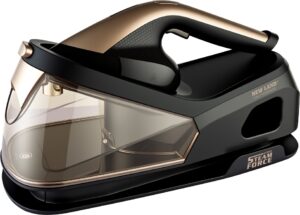
Some steam stations collect scale in a removable component. Open, clean, and reinstall it only after the appliance has cooled and depressurized as instructed.
Anti-scale cartridges
Replaceable cartridges have a finite service life that can depend on water hardness and usage. Replace them according to the appliance indicator or maintenance schedule.
Replaceable anti-scale filters
Some garment steamers and steam-cleaning appliances use separate anti-scale filters. Newland also has steam products with removable or replaceable anti-scale filtration, so maintenance should always be matched to the specific model rather than a generic rule.
Do not ignore the Calc indicator
If the appliance provides a scale warning, treat it as part of routine maintenance. Prolonged operation without the required cycle can reduce steam performance.
More descaling is not better
Over-descaling—especially with chemicals—can be harmful. The goal is correct maintenance at the recommended interval, not aggressive repeated cleaning.
What determines descaling frequency?
| Factor | Likely effect |
|---|---|
| Water hardness | Harder water generally increases scale formation. |
| Water volume used | More water introduces more dissolved minerals. |
| Usage frequency | More heating cycles can accelerate accumulation. |
| Anti-calc system | Changes the required maintenance method and interval. |
| Reservoir storage | Long standing-water periods can worsen conditions. |
What if you live in a hard-water area?
Find the approximate local hardness from the water supplier or a reliable test, then follow the appliance instructions for hard water. Do not improvise a chemical mixture.
Is TDS the same as hardness?
No. TDS estimates total dissolved solids, while hardness primarily relates to calcium and magnesium. A TDS reading alone does not fully describe scaling tendency.
Why does location matter?
Mineral composition, hardness, and alkalinity vary between regions. The same appliance can therefore require more frequent Calc-Clean in one city than another.
How scale weakens steam
Deposits can interfere with heat transfer or reduce the cross-section of water and steam passages, resulting in weaker or uneven output.
How scale can contribute to dripping
If mineral deposits interfere with a water-control valve or passage, liquid water may reach the soleplate before complete vaporization. Low temperature and overfilling can also cause dripping.
White particles from steam holes
These are often loosened mineral deposits. Use the approved Self-Clean/Calc-Clean method rather than scraping outlets with a needle.
Why not clean steam holes with metal tools?
Metal can damage the soleplate coating or outlet geometry and may push deposits farther inside.
If descaling does not restore steam
A severe blockage, pump fault, valve issue, thermostat problem, or another failure may exist. Repeated chemical descaling is not a safe substitute for technical inspection.
Scale in handheld steamers
A small tank does not prevent scale. Narrow steam paths can be sensitive to mineral deposits, making correct water and reservoir drainage important.
Scale in upright steamers
Higher water volume and a hose-based steam path make model-specific draining and descaling important. Do not fill hoses with improvised cleaning solutions.
Scale in steam stations
Because they process larger water volumes, collector, Calc-Clean, or cartridge maintenance should be considered part of normal ownership.
Scale in steam cleaners and steam mops
The principle is similar, but filtration can differ. Some models use replaceable anti-scale filters, so follow the manual for water type and replacement intervals.
Daily scale-prevention routine
- Use only the recommended water.
- Fill from a clean container.
- Do not exceed MAX.
- Do not add fragrance or chemicals.
- Manage remaining water according to the manual.
- Do not ignore a Calc warning at the next session.
Periodic routine
- Check the manual or maintenance indicator.
- Run Self-Clean/Calc-Clean exactly as specified.
- Service collectors only when cool and depressurized.
- Replace cartridges or filters when due.
- After maintenance, check for leaks and normal steam output.
Water checklist
- Have you checked the manufacturer’s water instructions?
- Do you know the approximate local water hardness?
- Is the water free from visible debris and unusual odor?
- Does the appliance restrict pure distilled water?
- Does your building use a central softener?
- Are you avoiding unapproved additives?
10 mistakes that increase scale problems
- Ignoring the recommended water type.
- Assuming bottled water is always better.
- Leaving water in the reservoir for long storage.
- Ignoring the Calc warning.
- Failing to replace a cartridge or filter.
- Using vinegar without approval.
- Adding fragrance or essential oils.
- Scraping outlets with metal.
- Descaling too frequently.
- Continuing to use severely weakened steam without investigation.
When should the appliance be serviced?
If correct descaling does not restore steam, brown particles continue to appear, leakage persists, the pump sounds abnormal, or a Calc warning will not clear, avoid opening the appliance at home and arrange technical inspection.
Conclusion
The best way to manage scale is to prevent heavy accumulation. Correct water, a clean reservoir, no unapproved additives, timely anti-calc maintenance, and proper after-use storage are the five foundations. Do not turn distilled water, vinegar, or any household remedy into a universal rule; each steam system has its own design and the exact model manual should make the final decision.
Common mistakes
Change only one variable at a time while diagnosing.
- Do not ignore the specified water type.
- Do not assume bottled water is always better.
- Do not leave water standing for long storage.
- Do not ignore the Calc warning.
- Do not delay cartridge or filter replacement.
- Do not use vinegar or citric acid without approval.
- Do not add fragrance or essential oils.
- Do not scrape steam holes with metal.
- Do not descale excessively.
- Do not continue with severe steam loss without investigation.
Frequently asked questions
Is distilled water always best for an iron?
No. Some manufacturers specify tap water or a particular mixture; follow the exact model manual.
Can I use vinegar for descaling?
Only if the manufacturer explicitly approves it.
Is TDS the same as water hardness?
No. Hardness mainly concerns calcium and magnesium, while TDS estimates total dissolved solids.
What should I do when the Calc light turns on?
Perform the anti-calc procedure specified in the manual.
Do white particles mean the appliance is broken?
They are often mineral deposits; first use the approved Self-Clean or Calc-Clean procedure.
Is frequent descaling better?
No. Excessive maintenance, especially with chemicals, can be harmful.