What Type of Ironing System Is Best for a High-Volume Household?
A detailed guide to choosing an ironing system for high-volume households, covering steam stations, upright steamers, continuous steam, reservoir capacity, ergonomics, ironing boards, and scale management.
For regular high-volume precision ironing, a steam station is usually the strongest primary system because it combines a larger reservoir and sustained steam with contact-ironing precision. Add an upright steamer if coats, long garments, and curtains are a major part of the workload.
What Type of Ironing System Is Best for a High-Volume Household?
A household that irons large loads several times a week needs different priorities from an occasional user. Wattage alone is not enough. Continuous steam, reservoir capacity, sustained performance, ergonomics, steam recovery, scale management, and the ironing board itself directly affect productivity.
Quick answer: For regular high-volume precision ironing, a steam station / steam generator iron is usually the strongest primary system because it combines a larger water supply and sustained steam with contact-ironing precision. If coats, long garments, and curtains form a major part of the workload, an upright garment steamer is a valuable companion.
What counts as high-volume use?
Family size alone is not a reliable definition. Measure the actual number of garments per session and how long the appliance runs continuously.
Signs your current system is undersized
- Multiple refills per session.
- Frequent waiting for steam recovery.
- Hand and wrist fatigue.
- Excessive time for one laundry basket.
- Too many passes on heavy fabrics.
- Repeated steam loss from scale buildup.
Why a conventional steam iron may become limiting
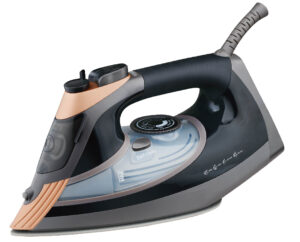
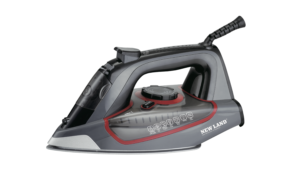
A good steam iron can deliver excellent results, but its smaller internal tank and the water carried in the hand-held body can become noticeable during long sessions.
Why a steam station fits large loads
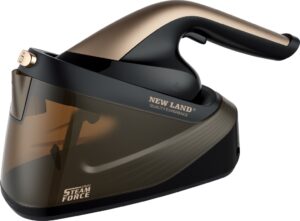
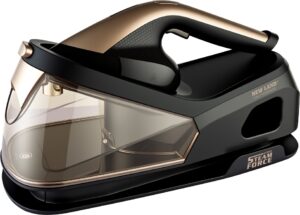
Its separate base can provide a larger reservoir and, in many designs, stronger sustained steam while preserving the precision of a heated soleplate.
Continuous steam matters most
For high-volume households, continuous output is generally more important than a headline Steam Boost figure. Boost is a short burst; continuous steam describes sustained delivery during routine work.
Should you compare g/min?
Yes, when the manufacturer provides a reliable specification, but distribution, stability, soleplate design, and temperature control also affect real performance.
Steam Boost and Bar
Boost is useful for stubborn creases and heavy fabrics. System pressure in Bar can be informative on steam stations, but neither number should be used alone to rank overall ironing quality.
Reservoir capacity and refill design
The goal is not the largest possible tank; it is enough capacity for your typical session. A removable tank and safe refill-during-use design can substantially reduce interruptions.
Heat-up time
For a one-hour session, sustained performance is usually more important than saving a few seconds at startup.
Hand-unit weight and ergonomics
Because the main water reservoir sits in the base, some steam-station hand units can feel lighter. Actual balance, handle geometry, hose routing, and soleplate glide still need to be assessed model by model.
Soleplate quality
Low friction, effective heat distribution, and useful steam-hole placement reduce effort across dozens of garments.
Manual or automatic temperature control?
Both can work. Manual systems provide direct control, while one-temperature or automatic systems reduce repeated setting changes. Garment care labels remain the governing limit.
Cotton, linen, uniforms, and shirts
Sustained steam and a precise soleplate tip matter more as workload rises. Controlled moisture can dramatically reduce the number of passes on dry heavy fabrics.
Coats and long garments
If these dominate the wardrobe, an upright steamer is a useful complement because it releases surface wrinkles while the garment remains hanging.
Curtains
Vertical steaming can be convenient when the curtain label permits it and outlets, motors, and other electrical equipment are kept safe from steam.
Bed linen and large textiles
A steam station paired with a large, stable ironing board is usually more efficient. A small board can cause already-ironed sections to wrinkle again.
The ironing board is part of the system
A powerful steam station on an unstable or poorly ventilated board is a bad combination. The board must support the base, manage moisture, and provide an ergonomic working height.
Board ventilation and height
High steam volumes require a cover and pad that do not trap excessive moisture. Correct height reduces sustained strain on the back, neck, and shoulders.
Sort garments before starting
Group clothing by required temperature. Working from lower-temperature fabrics toward more heat-tolerant ones reduces repeated setting changes and cooling delays.
Avoid over-drying
Bone-dry compressed fabrics often require more time. Prompt dryer removal or controlled residual moisture can make ironing easier.
Why two appliances can be more efficient
Use the steam station for shirts, trousers, linen, and precision pressing, and an upright steamer for coats, long garments, and rapid vertical wrinkle release.
Is a handheld steamer enough?
Usually not as the primary appliance for genuinely high-volume ironing. Its small tank and limited sustained output make it better as a secondary convenience tool.
Can an upright steamer replace a steam station?
Not for every task. It excels at vertical wrinkle release, but contact ironing gives more control for trouser creases, collars, cuffs, and a fully pressed finish.
Water quality and scale
The more water you process, the more scale management matters. Follow the appliance maker’s water instructions; do not automatically add distilled water, fragrance, or chemicals unless specifically permitted.
Anti-calc design
In hard-water areas, accessible descaling, collectors, or replaceable systems can be a primary purchase criterion rather than a minor feature.
Total cost of ownership
Consider cartridges, consumables, descaling effort, repairability, and accessory life in addition to the purchase price.
Electricity use
Rated wattage is not the whole energy-cost story because actual session length and thermostat/heater cycling also matter. Compare power together with how long you actually iron.
Safety in a busy home
Keep hot bases, cords, and hoses away from children, pets, and walkways. Never leave a hot appliance unattended.
Automatic shut-off
It is a useful extra safety layer, but it does not replace switching off and unplugging after use.
Storage and pump noise
Measure the real storage space before buying. Some steam stations make normal pump noise while moving water; users sensitive to sound should evaluate the specific model.
Specifications that matter most
| Specification | Why it matters |
|---|---|
| Continuous Steam | Sustained real-world performance |
| Tank Capacity | Number of refill interruptions |
| Refill Design | Convenience during long sessions |
| Anti-Calc | Long-term steam performance |
| Soleplate | Glide and steam distribution |
| Hand Unit Weight | Hand and wrist fatigue |
| Auto Shut-Off | Additional safety layer |
| Storage Lock / Cord Storage | Easier transport and storage |
Three practical scenarios
Moderate four-person household
If one or two medium loads are ironed each week, a capable conventional steam iron may still be completely sufficient.
Many uniforms and formal garments
A steam station can reduce refill interruptions while retaining the precision needed for shirts and trousers.
Many coats and long garments
A steam station for pressing plus an upright steamer for vertical work creates an efficient division of labor.
When does upgrading make sense?
Upgrade when the problem is the total time required for a full load: repeated refills, insufficient sustained steam, excessive passes, or fatigue during long sessions.
When is an upgrade unnecessary?
If sessions are short, the existing iron maintains stable steam, and one reservoir is sufficient, a larger system may add little practical value.
High-volume household buying checklist
- Measure typical session duration.
- Count current reservoir refills.
- Identify the dominant garment types.
- Compare continuous steam, not only Boost.
- Check tank capacity and refill method.
- Compare hand-unit weight and ergonomics.
- Review anti-calc maintenance and costs.
- Measure appliance and board storage space.
- Plan safe cord and hose routing.
- Check service support and consumables.
Common mistakes
- Buying a steam station based only on Bar.
- Ignoring continuous steam output.
- Choosing an oversized tank without considering storage.
- Using a weak board under a heavy system.
- Ignoring hard water and scale.
- Using a handheld travel steamer for large loads.
- Ignoring ergonomics.
- Buying before measuring storage.
- Adding fragrance to the tank without manufacturer approval.
- Leaving hoses and cords across walkways.
Conclusion
For a high-volume household, the best system is the one that minimizes interruptions and remains consistent throughout a long session. A steam station is a strong primary choice for large, precise ironing loads; an upright steamer is a valuable complement for hanging garments; and a stable board, good ergonomics, and disciplined scale maintenance are just as important to the final workflow.
Common mistakes
Change only one variable at a time while diagnosing.
- Do not buy based only on Bar.
- Do not ignore continuous steam.
- Do not choose a huge tank without considering storage.
- Do not place a steam station on an unsuitable board.
- Do not ignore hard water and anti-calc maintenance.
- Do not rely on a handheld steamer for large loads.
- Check weight and ergonomics.
- Measure storage before buying.
- Do not add fragrance unless the manufacturer permits it.
Frequently asked questions
Is a steam station better than a steam iron for a high-volume family?
For long sessions and large loads, its larger tank and sustained steam usually provide a clearer advantage.
Can an upright steamer replace a steam station?
It is excellent for vertical wrinkle release but not a complete replacement for precision pressing.
What specification matters most?
Continuous steam together with tank capacity and overall system design is more useful than a single wattage or Bar figure.
Is a larger tank always better?
No. It should match session length and available storage.
How important is the ironing board?
Very important; it must be stable, steam-compatible, and ergonomically adjusted.
When does an upgrade make sense?
When repeated refills, steam drop-off, excessive total time, or fatigue are genuine problems.