How to Choose the Right Stand Mixer Speed for Different Ingredients
Choose the right stand-mixer speed for dough, cake, cookies, cream, egg whites, meringue, and dry ingredients based on attachment, thickness, batch size, and recipe stage.

Dough hooks and heavy dough generally use the low range, flat beaters use low-to-medium speeds, and balloon whisks start around medium before increasing gradually. Start slower and increase only as needed; exact speed numbers are model-specific.
Before you start
How to Choose the Right Stand Mixer Speed for Different Ingredients
The correct mixer speed is not just the number on the dial. It depends on attachment type, mixture thickness, batch size, recipe stage, and the mixer’s real capacity. A useful rule is: heavy doughs use lower speeds, medium mixtures use low-to-medium speeds, and aerated foods such as cream and egg whites use a controlled start followed by higher speeds when needed.
Quick answer: Use the dough hook at the low manufacturer-recommended range for heavy dough. Use the flat beater at low-to-medium speeds for cakes, cookies, and creaming. With the balloon whisk, begin around a moderate speed and increase only after structure starts to form. Always start slower, then increase only as much as needed. Exact speed numbers are model-specific.
Quick speed guide by ingredient
| Task | Recommended setting | Important note |
|---|---|---|
| Bread and pizza dough | Low range | Use dough hook; avoid high speed |
| Creaming butter and sugar | Low → Medium | Butter should be at recipe temperature |
| Cake batter | Low → Medium | Do not overmix after adding flour |
| Whipped cream | Medium → Higher | Stop at the recipe’s target peak |
| Egg whites | Medium → Higher | Starting too fast creates coarse bubbles |
| Dry ingredients | Low | Prevents flour and powder from flying out |
Rule 1: always start slower
A low-speed start reduces splashing and gives the motor a smoother transition into load. Increase only after the mixture begins to come together.
Rule 2: the attachment matters
Dough hooks, flat beaters, and balloon whisks are designed for different loads. A speed suitable for a whisk can be inappropriate for heavy dough.
Rule 3: mixture thickness matters more than the recipe name
Two batters with the same name can behave very differently. If the motor slows significantly, do not simply raise the speed; check load, hydration, and attachment choice.
What speed for bread dough?
Use the dough hook in the low range specified by the manufacturer. The objective is controlled stretching and gluten development, not high RPM.
What speed for pizza dough?
Also low and model-specified. Hydration and batch size strongly affect mechanical load.
What about enriched dough such as brioche?
Follow the recipe’s staged method. Butter and eggs change dough behavior, so a universal speed rule should not replace the recipe.
What speed for combining flour and liquid?
Low speed is the safest starting point. It reduces flour clouds and lets ingredients combine gradually.
What speed for creaming butter and sugar?
Use a flat beater, start low, then move to medium once the ingredients are contained and blending smoothly.
What speed for cake batter?
Low-to-medium is common depending on the recipe stage. After flour is added, mix only until combined to avoid excess gluten development.
What speed for cookie dough?
Low-to-medium with the flat beater is usually appropriate. If the mixer is heavily loaded, more speed is not the solution.
What speed for cheesecake?
Low-to-medium is usually preferable with a flat beater because excessive aeration can change cheesecake texture.
What speed for frosting?
Start low to contain powdered sugar, then move to medium for a smoother texture. Some lighter frostings may use a whisk later.
What speed for whipped cream?
Start at medium with the balloon whisk, then increase after initial thickening if needed. Stop at the required soft, medium, or stiff peak.
What speed for egg whites?
A moderate start helps build finer initial bubbles. Increase gradually as the foam structure develops.
What speed for meringue?
Use staged speed control: moderate start, gradual sugar addition as the recipe specifies, then a higher finishing speed if needed.
What speed for pancakes and waffles?
Low-to-medium with the flat beater is enough. Excess mixing can make the final texture tougher.
What speed for light sauces or dips?
Low-to-medium depending on thickness. Very thin mixtures can splash if started too fast.
What speed for dry flour or cocoa?
Always start low. High speed on dry powder creates dust and ingredient loss.
When is Pulse useful?
Pulse can help with short controlled mixing or repositioning, but it is not a substitute for steady dough kneading or controlled whipping. Use it only as the model manual allows.
Why is higher speed not always better?
Higher RPM does not automatically improve mixing. In thick foods it can increase heat, vibration, and gearbox load.
Can speed be too low?
Yes. Whipping may progress very slowly and some mixtures may not circulate effectively. After a controlled start, move to an effective recipe-appropriate range.
Signs the speed is too high
- Ingredients splash out of the bowl.
- Dough climbs the hook.
- The mixer begins to walk or shake severely.
- The motor or gearbox sounds heavily loaded.
- The mixture heats faster than expected.
Signs the speed is too low
- The whisk runs for a long time with little volume increase.
- Ingredients remain nearly stationary at the bowl bottom.
- Initial mixing remains incomplete despite a suitable batch and attachment.
Does speed number mean the same thing on every mixer?
No. Speed 3 on one mixer is not necessarily equivalent to Speed 3 on another. Gear ratios, motor characteristics, bowl diameter, and planetary motion differ.
How should you think about a six-speed mixer?
Conceptually, lower settings are for starting and heavy dough, middle settings for mixing and creaming, and upper settings for whipping. Exact numbers should still follow the model manual.
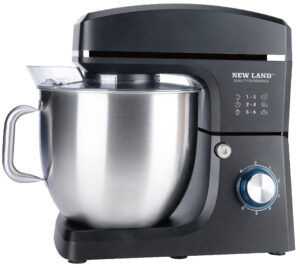
Does the Newland NL-3149BL have multiple speeds?
Yes. Newland lists the NL-3149BL with six speed levels plus Pulse. Recipe-specific speed numbers should still be checked against that model’s manual.
Why change speed gradually?
Jumping from low to maximum can create splashing, sudden mechanical load, and less control over texture. Gradual changes provide better control.
Can I knead faster to finish dough sooner?
No. Gluten development depends on time, hydration, and appropriate mechanical work. Excess speed adds heat and gearbox stress.
Is maximum speed always best for whipping?
No. A moderate start followed by a gradual increase generally produces more uniform foam.
Does bowl type affect speed?
Less than bowl size and geometry. The key is that the batch remains within the effective working zone of the correct attachment.
Does ingredient quantity affect speed?
Yes. Larger batches create more load. Heavy mixtures should not be compensated for with higher speed.
Does ingredient temperature matter?
Yes. Cold butter, cold dough, or warm cream behave differently. Correct ingredient conditions rather than using speed to compensate.
Step-by-step speed selection
- Identify the correct attachment.
- Assess mixture thickness.
- Compare batch size with actual mixer capacity.
- Start at low or the model’s recommended starting range.
- Increase gradually after initial mixing.
- Listen for motor strain and watch for vibration.
- If speed drops, reduce load rather than increasing speed.
- Use peak stages to stop whipping.
- Use recipe development and time for dough, not maximum RPM.
- Confirm exact speed numbers in the model manual.
Attachment × speed matrix
| Attachment | Start | Typical range | Avoid |
|---|---|---|---|
| Dough hook | Low | Low / model-specified | High speed on heavy dough |
| Flat beater | Low | Low → Medium | Overmixing and very heavy loads |
| Balloon whisk | Medium | Medium → Higher | Very thick mixtures |
10 common mistakes
- Starting immediately at maximum speed.
- Using high speed for heavy dough.
- Compensating for cold butter with more speed.
- Compensating for overload with more speed.
- Starting egg whites at maximum speed.
- Mixing dry flour at high speed.
- Ignoring attachment choice.
- Continuing after the target texture is reached.
- Copying speed numbers from another mixer model.
- Ignoring speed loss, vibration, or gear noise.
When is speed not the real problem?
If a light batch, correct attachment, and appropriate speed still produce severe speed loss, no-load vibration, gear noise, bowl contact, or unusual odor, the drive system needs assessment.
Conclusion
Instead of memorizing one speed number, ask three questions: Which attachment am I using? How thick is the mixture? What is the recipe trying to achieve? Dough hooks usually use low speeds, flat beaters low-to-medium, and whisks medium-to-higher. Start slower, increase gradually, and never use extra speed to compensate for overload or an unsuitable recipe.
Common mistakes
Change only one variable at a time while diagnosing.
- Do not start immediately at maximum speed.
- Do not use high speed for heavy dough.
- Do not compensate for cold butter with more speed.
- Do not compensate for overload with more speed.
- Do not start egg whites at maximum speed.
- Do not mix dry flour at high speed.
- Do not ignore attachment choice.
- Do not continue after the target texture is reached.
- Do not copy speed numbers from another mixer model.
- Do not ignore speed loss, vibration, or gear noise.
Frequently asked questions
What speed should I use for bread dough?
Usually the low manufacturer-recommended range with the dough hook; exact numbers should come from the model manual.
What speed should I use for cake batter?
Low to medium depending on the recipe stage; avoid overmixing after flour is added.
What speed should I use for whipped cream?
Start around medium and increase gradually after initial thickening if needed.
Should I start egg whites at maximum speed?
No. A moderate start generally produces finer, more stable initial foam before speed is increased.
Is Pulse suitable for kneading dough?
It is usually not a substitute for steady kneading; follow the model manual for Pulse use.
Is Speed 3 the same on every mixer?
No. Gear ratios and RPM differ, so speed numbers are not universal.