
Why Shouldn't You Overfill a Stand Mixer Bowl?
Learn why overfilling a stand mixer bowl can cause poor mixing, higher motor and gearbox load, vibration, splashing, and how to choose a practical batch size.
Do not fill the bowl to the rim. Practical capacity depends on ingredient type, thickness, attachment, and the model instructions. Leave extra headroom for heavy dough, cream, and egg whites. If ingredients reach the lid, mixer speed drops, or mixing becomes uneven, reduce the batch.
Before you start
Why Shouldn’t You Overfill a Stand Mixer Bowl?
Overfilling a stand mixer bowl does more than create spills. When ingredient volume exceeds the mixer’s practical working range, circulation becomes poor, attachments cannot reach the mixture effectively, motor and gearbox load rises, vibration can increase, and ingredients may splash toward the mixer head. Nominal bowl volume is therefore not the same as safe working capacity for every recipe.
Quick answer: Do not fill the bowl to the rim. Practical capacity depends on ingredient type, thickness, attachment, and the model instructions. Leave more headroom for heavy dough, whipped cream, and egg whites. Start dry ingredients at low speed. If ingredients reach the lid, spill out, mix unevenly, or the mixer shows speed loss or abnormal vibration, reduce the batch size.
Before filling the bowl
| Step or goal | Recommended method | Important note |
|---|---|---|
| Check quantity | Use the recipe and model manual | Bowl volume is not working capacity |
| Heavy dough | Use a smaller batch and more headroom | Dough creates high mechanical load |
| Cream and egg whites | Leave room for expansion | Both increase in volume while whipping |
| Dry ingredients | Add gradually and start slowly | Reduces flour and powder clouds |
| Liquids | Keep a safe distance from the rim | Reduces splashing and overflow |
| Signs of overfilling | Reduce the batch | Take speed loss and poor mixing seriously |
1. Nominal bowl size is not working capacity
An 8-liter bowl describes geometric bowl volume. It does not mean every recipe can safely use 8 liters of ingredients.
2. Ingredients need room to circulate
Good mixing requires ingredients to move through the attachment path, leave the bowl wall, and return toward the center.
3. Heavy dough creates the greatest load
A kilogram of stiff dough can impose far more mechanical resistance than the same weight of cream or cake batter.
4. Drier dough means higher load
Low-hydration dough is stiffer and harder for the hook to stretch and fold.
5. Cream expands while whipping
Cream needs headroom because air incorporation increases its volume.
6. Egg whites need even more expansion space
Egg-white foam can grow several times beyond its initial volume.
7. Cake batter can also rise during mixing
A bowl that starts near the rim may not have enough space once the batter aerates.
8. Dry powders can fly out
Flour, cocoa, and powdered sugar should be added gradually and mixed initially at low speed.
9. Liquids can splash toward the mixer head
Overfilling increases the chance that liquid reaches areas around the attachment connection or underside of the mixer head.
10. Overfilling reduces mixing quality
If the attachment only moves the center while upper or outer layers remain almost stationary, mixing will be uneven.
11. Attachments need working clearance
The dough hook, flat beater, and whisk each follow a designed path through the bowl.
12. Ingredients climbing the attachment can be a warning
Some dough climb is normal, but material approaching the attachment mount or mixer head suggests excessive volume, stiffness, or speed.
13. Speed loss is an important sign
If RPM falls clearly as ingredients are added, do not increase speed to compensate. Reduce the load.
14. Severe vibration can come from overloading
Heavy mixtures can create uneven cyclic forces that make the mixer shake or walk.
15. Do not ignore heavy clicking or knocking
New drive noise under load can indicate excessive stress on the gearbox or coupling.
16. Overload protection is not a normal operating strategy
If the mixer has thermal or overload protection, repeated activation is a warning rather than permission to keep overloading it.
17. Abnormal heating means load should be reviewed
Rapid heating, unusual odor, or shutdown should trigger a stop and load check.
18. Dough should not be judged by volume alone
Flour weight, hydration, flour type, and stiffness matter more than how high the dough sits in the bowl.
19. Cream needs room to grow
Choose an initial quantity that still leaves working headroom after whipping.
20. Egg whites need space for foam
Large volume growth means the bowl should not start too full.
21. Butter and sugar need room for creaming
Controlled creaming depends on repeated spreading and gathering around the bowl.
22. Do not add every staged ingredient at once
If the recipe specifies gradual addition, follow it. Staged addition helps control both mixing and bowl volume.
23. A splash guard does not increase capacity
A guard reduces splashing but does not create more safe working space inside the bowl.
24. Overfilling makes cleaning harder
Ingredients reaching the lid, shaft area, or mixer head create more difficult cleanup and raise the risk of moisture entering non-washable areas.
25. If ingredients are spilling, reduce quantity first
Speed changes are not the primary solution when the physical fill level is too high.
26. Poor mixing can simply mean too much food
A mixer can appear weak when ingredients actually lack enough room to circulate.
27. Too little food can also cause poor engagement
Very small batches may sit below the effective attachment path, so both extremes can reduce performance.
28. Should every bowl be filled only halfway?
No. There is no universal fraction. Heavy dough requires more conservative loading than many light liquids.
29. What about a maximum-fill marking?
If the bowl or manual provides a maximum line, respect it. The rim itself is not a safe-fill indicator.
30. Why do manufacturers list bowl size?
Bowl volume is a clear physical specification, while practical capacity varies by ingredient and recipe.
31. What about an 8-liter Newland mixer bowl?
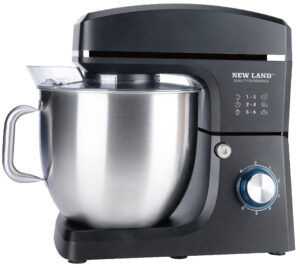
An 8-liter bowl provides generous space, but the number alone does not authorize filling to the rim. Actual ingredient quantity must follow the recipe, attachment, and model guidance.
32. A powerful motor does not remove capacity limits
Even strong motors and metal gears have designed operating ranges.
33. More speed does not create more capacity
Increasing speed can add heat, splashing, and mechanical stress without solving overfilling.
34. Start smaller with unfamiliar recipes
For a new dense recipe, begin with a moderate batch and observe mixer behavior.
35. Doubling a recipe may require two batches
A doubled recipe is not automatically suitable for one mixing cycle.
36. Splitting the batch can improve quality
Smaller batches usually allow better attachment access and more even mixing.
37. Do not hold a moving mixer down by hand
If excessive load makes the mixer walk, stop and correct the cause.
38. Never scrape a running bowl
Stop the mixer completely before using a spatula.
39. Rest can reduce load in some thick doughs
Some doughs soften after hydration rest, reducing resistance without extra speed.
40. Repeated overload shutdowns mean the batch is too demanding
Allow cooling, then correct the load before restarting.
Practical signs of overfilling
- Ingredients reach the rim or splash guard.
- Flour or liquid spills out.
- The upper mixture remains almost stationary.
- Mixing is uneven.
- Mixer speed drops under load.
- Vibration increases noticeably.
- Dough climbs toward the attachment mount.
- The motor or gearbox sounds heavily loaded.
What should you do if the bowl is overfilled?
- Stop the mixer.
- Unplug it.
- Wait for the attachment to stop completely.
- Transfer part of the mixture to another container.
- Clean the bowl rim and attachment area.
- Lock the bowl correctly again.
- Restart at low speed.
- If speed loss or vibration remains, reduce the batch further.
Headroom guide by ingredient type
| Ingredient type | Headroom needed | Reason |
|---|---|---|
| Heavy dough | High | Mechanical load and dough movement |
| Soft dough | Medium to high | Stickiness and hook movement |
| Cream | High | Volume expansion while whipping |
| Egg whites | High | Large foam expansion |
| Cake batter | Medium | Circulation and aeration |
| Dry powders | Medium | Reduce dust and splashing |
10 common mistakes
- Treating bowl volume as actual ingredient capacity.
- Filling the bowl to the rim.
- Increasing speed to compensate for excessive volume.
- Doubling a recipe without checking mixer capacity.
- Ignoring cream and egg-white expansion.
- Adding all dry ingredients at once.
- Continuing despite severe speed loss.
- Ignoring heavy vibration and drive noise.
- Holding the mixer down by hand.
- Relying on overload protection as a normal operating method.
When should you stop using the mixer?
Stop and unplug if ingredients reach the attachment connection or mixer head, the mixer walks across the counter, clicking or grinding develops, unusual odor appears, an attachment strikes the bowl, or overload protection repeatedly activates.
When is service appropriate?
If speed loss, severe vibration, gearbox noise, or bowl contact remains after reducing the batch, choosing an appropriate speed, and confirming correct bowl and attachment installation, the problem may extend beyond capacity and the drive system should be assessed.
Conclusion
A large bowl does not mean unlimited fill. Practical mixer capacity depends on ingredient type, thickness, quantity, attachment, and model guidance. Leave extra headroom for heavy dough, cream, and egg whites, add ingredients gradually, and never compensate for overload by increasing speed. Correct batch size improves both food quality and mixer longevity.
Common mistakes
Change only one variable at a time while diagnosing.
- Do not treat bowl volume as actual ingredient capacity.
- Do not fill the bowl to the rim.
- Do not increase speed to compensate for excessive volume.
- Do not double a recipe without checking mixer capacity.
- Do not ignore cream and egg-white expansion.
- Do not add all dry ingredients at once.
- Do not continue despite severe speed loss.
- Do not ignore heavy vibration and drive noise.
- Do not hold the mixer down by hand.
- Do not rely on overload protection as a normal operating method.
Frequently asked questions
Can an 8-liter bowl be filled with 8 liters of ingredients?
Not necessarily. Eight liters is the bowl volume; safe working quantity depends on ingredient type, thickness, attachment, and model guidance.
Why does heavy dough need more headroom?
Because the dough mass moves during kneading and creates high mechanical load on the attachment and drive.
Why should cream and egg whites not start too full?
Because both expand during whipping and need room to build structure safely.
What should I do if the mixer slows under load?
Stop and reduce the batch; increasing speed is not the correct solution.
Does a splash guard increase bowl capacity?
No. It only helps control splashing and does not increase the bowl's working capacity.
When is technical assessment needed?
When major speed loss, severe vibration, or gearbox noise remains after reducing the batch and choosing the correct speed.
Related guides and products


Still having the problem?
If safe user-level checks do not solve the issue, do not open the appliance. Submit a service request for technical inspection.