What Do 15-Bar and 20-Bar Espresso Pump Ratings Really Mean?
A 15-bar or 20-bar rating usually describes maximum pump capability, not constant brewing pressure. Learn why controlled extraction around 9 bar, temperature, and grinding matter more than the larger number.

A 20-bar machine is not automatically better than a 15-bar machine. These figures usually describe nominal pump capability, while many capable machines with 15-bar pumps control the main extraction stage at around 9 bar.
Quick comparison
What does 15-bar or 20-bar pump pressure mean in an espresso machine?
When an espresso machine specification lists 15 bar or 20 bar, it usually refers to the pump’s rated or maximum pressure capability. It does not mean that coffee is necessarily brewed at that pressure throughout extraction. Comparing machines only by this number can therefore be misleading.
Quick answer: a 20-bar machine does not automatically make better espresso than a 15-bar machine. Many well-designed home machines use a pump with higher pressure capability while controlling the main extraction stage at around 9 bar. The result depends more on pressure and flow management, water temperature, grind size, coffee dose, and preparation consistency.
What is a bar?
Bar is a unit of pressure. One bar is approximately close to atmospheric pressure at sea level. When a manufacturer describes a pump as 15 bar or 20 bar, that figure describes a pump specification and should not automatically be treated as the pressure applied to the coffee bed throughout the entire extraction.
Why use a 15-bar pump if espresso is extracted at around 9 bar?
The pump needs sufficient capability to move water through the hydraulic system and the resistance created by the coffee bed. The machine can then manage the pressure used during brewing. For example, some home espresso machines equipped with 15-bar pumps begin with lower-pressure pre-infusion and perform the main extraction stage at around 9 bar.
Is a 20-bar pump more powerful?
It may have a higher nominal pressure capability, but that alone does not create a quality advantage in the cup. The more useful question is what pressure and flow the machine produces while water passes through the coffee and whether it controls those conditions consistently.
Does higher pressure create more crema?
There is no simple direct relationship. Crema appearance is influenced by coffee freshness and type, retained gas, grind, basket design, and extraction conditions. A large amount of crema is not by itself proof of better flavor. A larger pump-pressure number should therefore not be equated with better crema or better espresso.
What happens if actual brewing pressure is too high?
Pressure is only one variable in a system that also includes coffee-bed resistance and water flow. Poorly controlled conditions can contribute to uneven extraction. The objective of a capable espresso machine is therefore not to generate the highest possible pressure, but to create controlled and repeatable brewing conditions.
Does a low pressure-gauge reading always mean the pump is faulty?
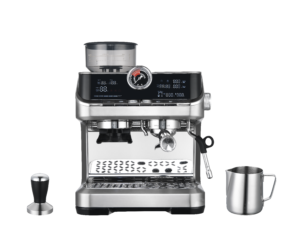
No. On machines with a brewing-pressure gauge, a low reading can result from coffee that is ground too coarsely, insufficient coffee dose, or a coffee bed that offers too little resistance. Check grind size, dose, basket condition, and preparation before concluding that the pump has failed.
Which specifications matter more than 15 or 20 bar?
- Brewing-pressure control: more informative than maximum pump capability.
- Temperature stability: large temperature changes can reduce shot-to-shot consistency.
- Heating system: affects warm-up, repeatability, and steam performance.
- Suitable grinder: grind size directly changes coffee-bed resistance and water flow.
- Basket and portafilter: their design affects extraction behavior and workflow.
- Flow control and pre-infusion: suitable designs can promote a more even start to extraction.
15 bar or 20 bar: which should you choose?
| Specification | What it actually tells you |
|---|---|
| 15-bar pump | Rated pump capability; entirely sufficient for many capable home espresso machines |
| 20-bar pump | Higher nominal capability; not proof of better espresso by itself |
| Around 9-bar extraction | A widely used reference point in many espresso systems |
| Pressure and temperature control | More relevant to quality and repeatability than maximum pump pressure |
Is 9 bar an absolute rule?
No. Around 9 bar is a well-established and widely used reference for espresso extraction, but machines and brewing approaches can use different pressure profiles. Some systems begin with lower-pressure pre-infusion before increasing pressure. Even the 9-bar figure should therefore be understood within the complete brewing process.
A simple example
Imagine two machines. The first has a 15-bar pump and controls brewing pressure and temperature effectively. The second advertises 20 bar but provides weaker thermal and extraction control. The pump number alone gives no reason to assume that the second machine will make better espresso. The larger figure describes pump capability, not cup quality.
What should you ask when comparing machines?
Instead of asking only how many bars the pump produces, ask how brewing pressure is managed, whether the machine uses pre-infusion, how stable the brewing temperature is, what heating system it uses, and whether your grinder and basket system provide adequate control over flow. These questions give a much more useful picture of real performance.
Common mistakes
- Assuming 20 bar is always better than 15 bar.
- Assuming the number on the box is the constant pressure applied to the coffee.
- Blaming every low pressure reading on a faulty pump.
- Ignoring grind, dose, and temperature when evaluating extraction.
- Choosing an espresso machine by one headline specification alone.
Summary
A 15-bar or 20-bar figure mainly describes nominal pump capability rather than espresso quality. A machine with a 15-bar pump can control the main extraction stage at around 9 bar and produce excellent results. When choosing a machine, focus on actual pressure and flow management, temperature stability, heating design, grinding, and overall system quality rather than simply choosing the largest number on the box.
Pump rating is not the same as coffee-bed pressure
A 15- or 20-bar label generally describes pump capability, not the pressure applied to coffee throughout the shot. Temperature stability, flow, grind quality, and basket design matter more than a larger pump number alone.
Common mistakes
Change only one variable at a time while diagnosing.
- Do not assume 20 bar is always better than 15 bar.
- Do not confuse nominal pump pressure with constant pressure on the coffee bed.
- Do not attribute every low pressure reading to pump failure.
- Do not ignore grind, coffee dose, and temperature when evaluating pressure.
- Do not choose an espresso machine only by the largest number on the box.
Frequently asked questions
Is a 20-bar espresso machine better than a 15-bar machine?
Not necessarily. Nominal pump pressure alone does not determine extraction quality.
Why does a machine have a 15-bar pump if espresso is discussed at around 9 bar?
The pump has higher pressure capability while the machine design can regulate the main extraction stage at around 9 bar.
Is 9 bar always mandatory?
No. Around 9 bar is a common reference, while some machines use different pressure profiles and lower-pressure pre-infusion.
Does low pressure mean the pump is broken?
No. Coarse grinding, insufficient coffee dose, and inadequate coffee-bed resistance can also produce low pressure.