
Why Does Espresso Flow Unevenly from the Two Portafilter Spouts?
Uneven output from two portafilter spouts is often related to machine level, outlet blockage, coffee distribution, or tilted tamping rather than pump pressure alone.
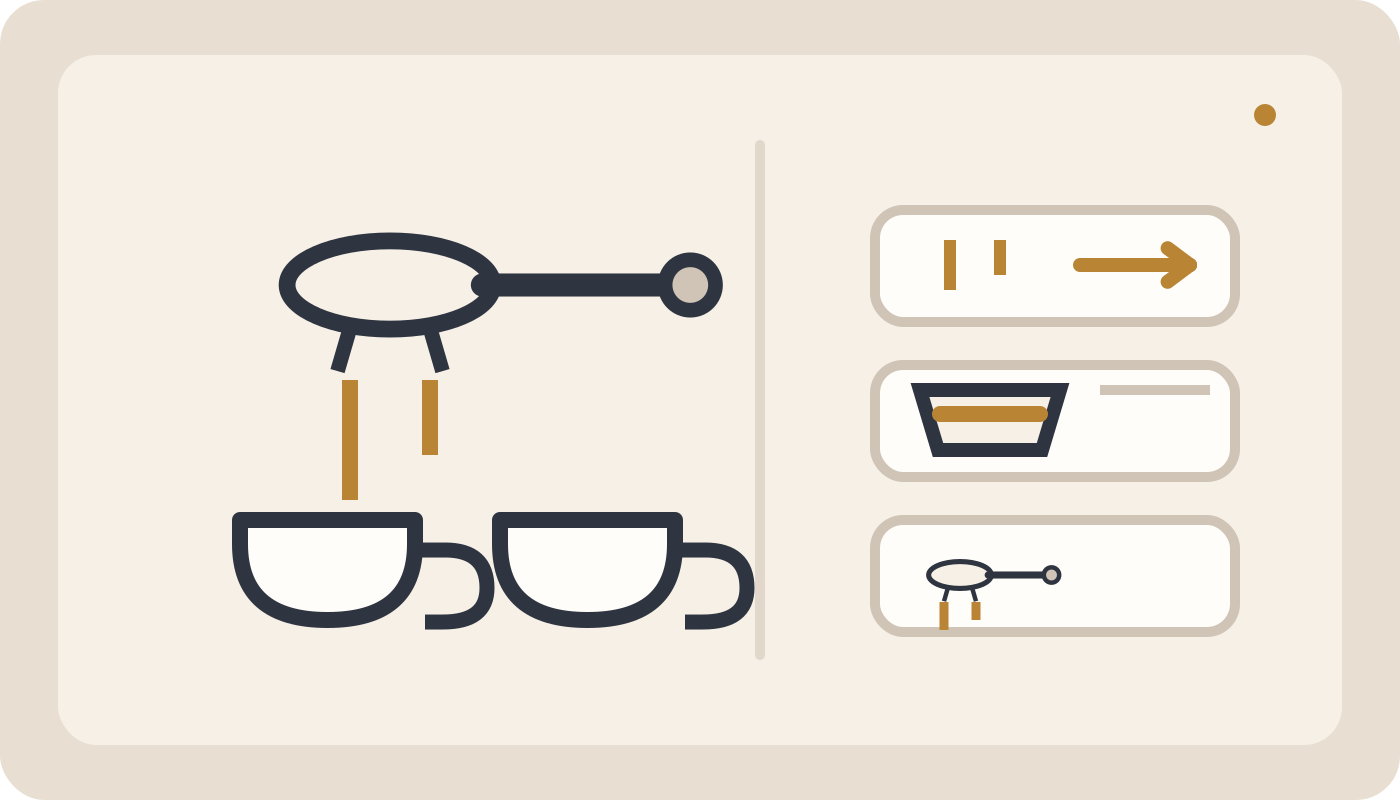
Level the machine, clean both portafilter spouts and the basket, use a dry basket, distribute coffee evenly, and tamp straight. If shot time, total yield, and flavor are normal, a small difference may come from outlet geometry or tilt. A severe fixed difference that remains after cleaning needs further inspection.
Where should you start?
Why Does Espresso Flow Unevenly from the Two Portafilter Spouts?
When one portafilter spout delivers more coffee than the other, low pump pressure is not automatically the cause. Machine level, spout blockage, basket cleanliness, uneven coffee distribution, and tilted tamping are common factors. Unequal spout output alone also does not prove that extraction through the coffee bed was uneven.
Quick answer: First place the machine on a level surface and clean both portafilter spouts. Use a clean dry basket, distribute coffee evenly, and tamp level. If total shot time, volume, and flavor are normal while one cup fills slightly faster, the difference may come from portafilter angle or the outlet path. If uneven flow appears together with spraying, unstable taste, or severe side-to-side differences, coffee preparation and water distribution need closer review.
Identify the pattern first
| Symptom | More likely cause | First check |
|---|---|---|
| The same spout always flows more | Tilt or outlet blockage | Level and spout cleanliness |
| The stronger side changes each shot | Uneven coffee preparation | Distribution and tamping |
| Coffee sprays unpredictably | Irregular flow through the coffee bed | Grind, distribution, and tamp |
| Both spouts are very slow | High resistance or blockage | Grind, dose, and water path |
| Both spouts are very fast | Low coffee-bed resistance | Grind and dose |
1. Place the machine on a level surface
A small counter slope can make liquid favor one side after leaving the basket.
2. Make sure the portafilter locks normally
Abnormal locking position can point to basket, rim, or group-fit issues.
3. Perform a short water-only check when the manual allows it
This can help separate outlet-path issues from coffee preparation.
4. If the difference remains without coffee
Tilt, blockage, or mechanical outlet geometry becomes more likely.
5. Clean both portafilter spouts
Coffee oils and fine particles can partially restrict one path.
6. Avoid sharp metal tools
Scratching or deforming the outlet can create a new problem.
7. Keep the basket clean
Blocked holes in one area can change resistance.
8. Inspect the basket against light
Look for sections with obvious persistent blockage.
9. Dry the basket before dosing
Uneven moisture can make coffee stick and distribute poorly.
10. Do not leave a mound in the center
Spread the coffee evenly before tamping.
11. Break up obvious clumps
Dense clumps and loose areas can create different flow paths.
12. Check the coffee surface before tamping
Left and right sides should be close to the same height.
13. Keep the portafilter level during distribution
Holding it at an angle encourages coffee to collect on one side.
14. Tamp straight and level
A tilted coffee bed can create unequal resistance.
15. Extra tamping force does not fix poor distribution
It can simply compress the existing unevenness.
16. Inspect the finished coffee bed
The surface should appear level rather than visibly tilted.
17. Clean coffee from the basket rim
Loose grounds can interfere with proper seating and sealing.
18. Unequal spouts do not always mean unequal extraction
After coffee leaves the basket, it enters a common lower chamber and then splits between outlets. Small tilt or geometry differences can affect that split.
19. Evaluate taste and shot time too
If total yield, time, and flavor are good, a small spout difference may be mostly cosmetic.
20. Large repeatable differences still deserve attention
If one cup remains nearly empty, inspect the outlet path and preparation more carefully.
21. Use two matching cups for testing
Different cup shapes can make visual comparison misleading.
22. Compare cup weights for a more precise test
A kitchen scale can quantify the difference.
23. Use fresh coffee for every test
Do not reuse an already extracted coffee bed.
24. If the stronger side changes every time
Coffee distribution is more likely than a fixed blocked spout.
25. If the same side always dominates
Level, spout geometry, and fixed blockage become higher priorities.
26. Do not confuse this with globally fast flow
If both spouts run fast and pale, overall coffee-bed resistance is the main issue.
27. Globally slow flow is a different problem
If both spouts drip slowly, grind, dose, or water-path restriction may be involved.
28. Pump pressure usually affects total flow
General pressure loss normally reduces overall extraction rather than weakening only one fixed spout.
29. That is why this differs from low-pressure troubleshooting
Start with outlet splitting and coffee-bed preparation.
30. Keep the group water screen clean
Localized residue can disturb water distribution over the basket.
31. Do not disassemble group components without instructions
If ordinary cleaning does not solve the issue, use qualified service.
32. Change one preparation variable at a time
Changing grind, dose, and tamp together makes diagnosis difficult.
33. Fix distribution first
Once distribution and tamping are consistent, adjust grind only if necessary.
34. Excessive dose can create contact problems
An overfilled basket can contact the water screen and disturb the surface.
35. Too little coffee can also reduce consistency
Use a dose appropriate to the basket design.
36. Single and double baskets behave differently
Internal shape and appropriate dose can differ.
37. Pressurized baskets change diagnosis
Much of the flow control occurs at a restricted outlet, so unequal spouts may come from the path after the basket.
38. Conventional baskets rely more directly on preparation
Distribution, grind, and tamping have a stronger effect on water flow through the coffee bed.
39. Leakage around the portafilter is another issue
If coffee escapes around the group connection, sealing should be diagnosed separately.
40. Never remove a pressurized portafilter prematurely
Allow the machine to finish its cycle and follow the manual before unlocking it.
Step-by-step diagnosis
- Level the machine.
- Clean both spouts and the basket.
- Run a short water-only check only when permitted.
- Use a clean dry basket and the correct dose.
- Distribute coffee evenly.
- Tamp level.
- Extract into matching cups.
- If the difference is fixed, recheck the outlet path and level.
- If the stronger side changes, improve coffee preparation.
- Use qualified service if a severe difference remains.
Quick troubleshooting table
| Condition | Likely cause | Action |
|---|---|---|
| Left spout always flows more | Tilt or outlet restriction | Level and clean |
| Stronger side changes | Uneven distribution or tamp | Improve preparation |
| Both flows are very fast | Coarse grind or low resistance | Review fast-flow setup |
| Both flows are very slow | Fine grind or blockage | Review slow-flow setup |
| Leakage around portafilter | Seal or gasket issue | Review group sealing |
| One path stays almost blocked after cleaning | Deep blockage or damaged part | Qualified service |
When service is appropriate
Seek service when one outlet remains almost blocked after cleaning, the portafilter is visibly damaged, the connection is loose, water distribution from the group is strongly one-sided, or the same severe problem occurs with different baskets and careful preparation.
Common mistakes
- Assuming every spout difference is a pump-pressure problem
- Tamping before even distribution
- Tamping at an angle
- Dosing into a wet basket
- Ignoring spout cleaning
- Changing grind, dose, and tamp simultaneously
- Removing the portafilter while pressure remains
- Using sharp metal tools to clear outlets
- Ignoring counter level
- Judging only by spout appearance without considering flavor and shot time
Conclusion
Unequal flow from two spouts is first a level, outlet-path, and coffee-preparation question, not automatically a pump-pressure fault. Level the machine, clean the basket and spouts, distribute evenly, and tamp straight. If a severe fixed difference remains, the outlet path or water distribution needs professional inspection.
Common mistakes
Change only one variable at a time while diagnosing.
- Do not blame every spout difference on pump pressure.
- Do not tamp before even distribution.
- Do not tamp at an angle.
- Do not dose into a wet basket.
- Do not ignore portafilter-spout cleaning.
- Do not change several variables at once.
- Do not remove the portafilter while pressure remains.
- Do not use sharp metal tools to clear outlets.
- Do not ignore machine level.
- Do not judge extraction only from spout appearance.
Frequently asked questions
Why does more coffee come from one portafilter spout?
Machine tilt, a restricted spout, or uneven coffee preparation are common causes.
Does unequal flow mean low pump pressure?
Not necessarily. General pressure loss usually affects total flow, so local causes should be checked first.
Can tilted tamping cause the problem?
Yes. A tilted coffee bed can create different resistance across the basket.
What if one side is weak even without coffee?
Check machine level and the outlet path, then use qualified service if the problem remains.
Is a small difference between two spouts normal?
When time, total yield, and flavor are good, a small difference can come from outlet geometry or slight tilt.
When is service needed?
Use service when one path remains almost blocked after cleaning, the portafilter is damaged, or group-water distribution is clearly one-sided.
Related guides and products
Still having the problem?
If safe user-level checks do not solve the issue, do not open the appliance. Submit a service request for technical inspection.